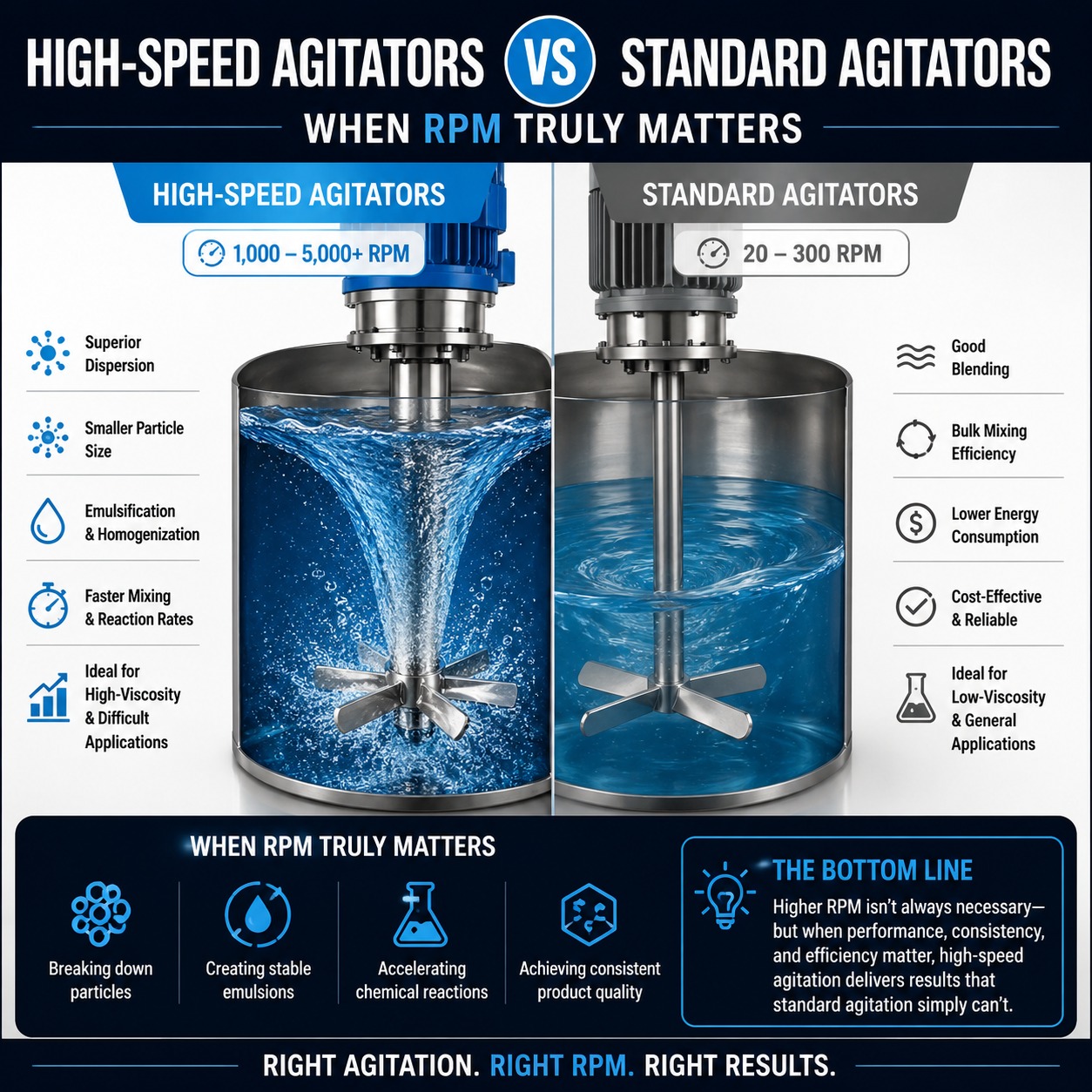
A practical, engineering-first guide to understanding when high rotational speed is a process advantage — and when it's simply expensive overkill.
In industrial mixing, the terms "high-speed" and "standard" agitators get thrown around loosely, but they mean something very specific to a process engineer. The difference isn't just a number on a nameplate. It's a fundamental choice about how mechanical energy is converted into fluid motion — and getting it wrong costs money in multiple ways.
Generally speaking, standard agitators operate at 20–300 RPM, using large-diameter impellers to generate bulk flow with low shear. High-speed agitators, by contrast, typically operate between 500 and 3,500 RPM, using smaller, high-energy impellers to generate turbulence, shear, and rapid dispersion.
But RPM alone does not define agitator performance. The tip speed of the impeller — calculated as π × diameter × RPM — is the more honest metric. A 2-metre-diameter anchor running at 40 RPM achieves a much higher tip speed than a 0.15-metre Cowles blade at 300 RPM. This is why engineering decisions based purely on RPM often go wrong.
Expert Perspective
"The right question is never 'what RPM should I run?' The right question is 'what fluid dynamic regime does my process actually need?' RPM is the output of that answer — not the input."
Understanding the operating principles of each type clarifies why they are suited to different tasks. The physics are straightforward; the engineering judgment comes from matching those physics to your process requirements. Modern fluid mixing technologies go beyond simple RPM selection — combining impeller design, flow behaviour, and process requirements to achieve efficient and reliable mixing performance.
Standard (Low-Speed) Agitator
20–300 RPM
Standard agitators rely on bulk fluid circulation as their primary mechanism. Large impeller geometries — hydrofoils, pitched-blade turbines, anchor types, and marine propellers — sweep large volumes of liquid through the tank at relatively low velocity, producing good axial or radial flow, consistent temperature distribution, and gentle but thorough blending.
High-Speed Agitator
500–3,500 RPM
High-speed agitators work through localised high shear and turbulent energy dissipation. Cowles discs, rotor-stator heads, and saw-tooth dispersers spin at speeds that create intense velocity gradients in the fluid immediately surrounding the blade tips — ideal for emulsification, dispersion, and particle size reduction.
Common Misconception
High-speed agitators are not "better" at mixing — they are better at a specific kind of mixing. In a 50,000-litre tank, a high-speed agitator positioned centrally will create a vortex around itself and barely affect the bulk fluid.
RPM becomes a critical variable under the following process conditions. Each factor deserves careful evaluation before equipment selection.
Factor 01
Viscosity is arguably the single most important variable. In low-viscosity fluids (below 100 cP), both types can achieve turbulent flow. In high-viscosity systems (above 10,000 cP), high-speed impellers become ineffective — slow-speed large-geometry impellers (gate, anchor, helical ribbon) are the only viable option.
Factor 02
When processing shear-sensitive materials, high RPM is often more harmful than beneficial. This includes mammalian cell cultures (cell lysis above a critical shear threshold), high-molecular-weight polymer solutions (irreversible chain scission), and stabilised emulsions (structure destruction). Standard agitators preserve both yield and product quality.
Factor 03
Certain processes fundamentally require the high shear that only elevated RPM delivers. Producing a stable oil-in-water emulsion with droplets below 5 microns, dispersing hydrophobic powders into aqueous systems, or achieving sub-micron particle sizes — none of these are achievable with bulk flow alone.
Factor 04
In batch processes where cycle time matters, higher RPM often reduces blend time — but with diminishing returns and a rising energy penalty. The relationship between RPM and blend time follows a power law: doubling the speed does not halve the blend time.
Factor 05
High-speed agitators are inherently difficult to scale up. As tank diameter increases, maintaining the same tip speed requires progressively larger motors and creates structural challenges. Standard agitators with proven scale-up rules are generally more predictable across scales.
Engineering Tip
Before specifying a high-speed agitator purely for blend time reduction, calculate the Reynolds number at your target operating condition. If your process is already in the turbulent regime at standard speeds, increasing RPM will reduce blend time only marginally while significantly increasing power consumption and mechanical wear.
The table below distils the key engineering and operational differences across the parameters that matter most in industrial agitator selection decisions.
| Parameter | High-Speed Agitator | Standard Agitator |
|---|---|---|
| Typical RPM Range | 500–3,500 RPM | 20–300 RPM |
| Primary Mechanism | High shear, turbulent dispersion | Bulk circulation, axial/radial flow |
| Suitable Viscosity | Low–medium <5,000 cP | Low–very high <500,000 cP |
| Impeller Diameter | Small (0.1–0.4× tank dia.) | Large (0.3–0.9× tank dia.) |
| Power Consumption | High per unit volume | Lower per unit volume |
| Scale-Up | Challenging | Well-established correlations |
| Shear-Sensitive Use | Not recommended | Recommended |
| Emulsification | Excellent | Limited |
| Mechanical Wear | Higher (bearings, seals) | Lower |
| Foam Generation | High risk | Low to moderate |
| Operating Cost (TCO) | Higher energy + maintenance | Lower energy + maintenance |
The right agitator type varies significantly by industry. Here is how standard and high-speed configurations divide across the major process sectors.
Standard agitators dominate bioreactor design for mammalian cell culture, keeping shear stress below critical thresholds. Marine-type impellers and hydrofoils are common. High-speed agitators appear at the formulation stage for dispersing APIs into carrier vehicles and producing emulsion-based creams.
The home territory of high-speed dispersers. Wetting out pigment powders into resin systems and breaking down agglomerates requires tip speeds of 15–25 m/s that only Cowles-type dispersers deliver. Standard agitators are used for let-down operations where shear is no longer needed.
Standard agitators handle fermentation vessels, beverage blending, and sauce preparation. High-speed homogenisers are used for dairy emulsification, mayonnaise production, and infant formula mixing, where droplet size distribution carries regulatory implications.
Standard agitators handle the majority of tasks: liquid blending, heat transfer, and solid suspension. High-speed agitators find their place in specialty chemical production — surfactants, polymer dispersions, and reactions where high interfacial area is needed to drive mass transfer.
Cosmetic formulation relies heavily on high-speed mixing for emulsification, powder dispersion, and achieving specific rheological textures. Vacuum processing combined with high-speed agitation is standard, allowing shear-driven emulsification while preventing destabilising air incorporation.
Agitator selection is a structured engineering decision, not a product preference. This five-step framework leads to defensible, cost-effective choices.
The objective is one of: homogenising miscible liquids, suspending solids, dispersing immiscible liquids (emulsification), incorporating gas (aeration), facilitating heat transfer, or driving a chemical reaction. Each has a different optimal fluid dynamic condition.
You need, at minimum: viscosity (ideally as a function of shear rate if non-Newtonian), density, temperature range, and any shear sensitivity thresholds. Without these inputs, agitator selection is guesswork.
Use the mixing Reynolds number (Re = ρND²/μ) to determine whether your process requires laminar, transitional, or turbulent conditions. High-speed agitators only deliver their intended performance in the turbulent regime (Re > 10,000).
Calculate the power number (Po) for your chosen impeller and verify the required motor size is practical for your installation. High-speed agitators in dense or viscous media often require disproportionately large motors that change the economics of the selection entirely.
Quick Decision Guide
Even experienced project teams fall into these traps. Recognising them early prevents costly redesigns, process failures, and premature equipment replacement.
The instinct to "add more mixing" by specifying a higher-speed unit frequently backfires. In fermentation, excess agitation destroys the culture. In polymer blending, it causes chain degradation. In pigment dispersion, over-milling past the optimum shear input causes re-agglomeration. More RPM is more of a specific energy input — which can be too much as easily as it is too little.
An agitator is a component of a system that includes the tank, baffles, nozzle positions, and headspace. A high-speed agitator in an unbaffled tank will create a stable vortex that pulls surface air into the process fluid and provides minimal bulk mixing — regardless of how powerful the motor is.
Scale-up based on equal RPM from pilot to production is almost always wrong. The correct approach uses dimensionless groups — Reynolds, Power, and Blend numbers — to preserve the fluid dynamic regime. Production-scale agitators run at significantly lower RPM than pilot equivalents while delivering equivalent mixing quality.
High-speed agitators are mechanically demanding. Seals and bearings at 1,500–3,000 RPM require more frequent replacement. A unit consuming 15 kW instead of 5 kW adds roughly ₹10,000–15,000 per year in electricity costs at typical industrial run hours — rarely factored adequately into initial capital comparisons.
Answers to the most common engineering questions we receive when teams are evaluating high-speed versus standard agitator configurations.
After examining the mechanics, applications, and selection criteria, one conclusion is clear — the debate between high-speed and standard agitators is a false binary.
It is: "Which fluid dynamic regime does my specific process require, and which agitator configuration delivers that regime most efficiently and reliably at my operating scale?"
High-Speed Is Genuinely Superior For
Standard Speed Is Genuinely Superior For
Modern Fluid Mixing Technologies reinforce this approach by prioritising fluid behaviour, process objectives, and system efficiency rather than RPM alone. The most effective mixing solution is one that delivers the desired process outcome with maximum reliability and minimum long-term operational cost.
Invest the time in fluid characterisation, process objective definition, and Reynolds number calculation upfront. The result will be an agitator that does exactly what your process needs — at the lowest sustainable cost, for the life of the equipment.