In mixing and agitation, a single seal failure can shut down an entire production line. For processes handling toxic chemicals, pharmaceutical compounds, radioactive fluids, or ultra-pure media, the stakes are even higher; a leak is not just a maintenance issue; it's a safety and compliance emergency.
Two technologies sit at the centre of the leak-free mixing conversation: magnetic mixers (also called magnetically coupled agitators) and mechanical seal agitators. Both are among the most widely used fluid mixing technologies in pharmaceutical, chemical, food, and specialty processing industries. Both are engineered to contain process media, but they take fundamentally different approaches, and those differences matter enormously when you're specifying equipment for a sensitive or regulated process.
This article gives you a thorough, honest comparison of both technologies, covering how they work, where each performs best, and how to make the right selection for your specific application. If you're an engineer, production manager, or procurement specialist evaluating mixing equipment, this is the guide you need before specifying anything.
Understanding the leak-prevention mechanism of each system is the foundation of any honest comparison.
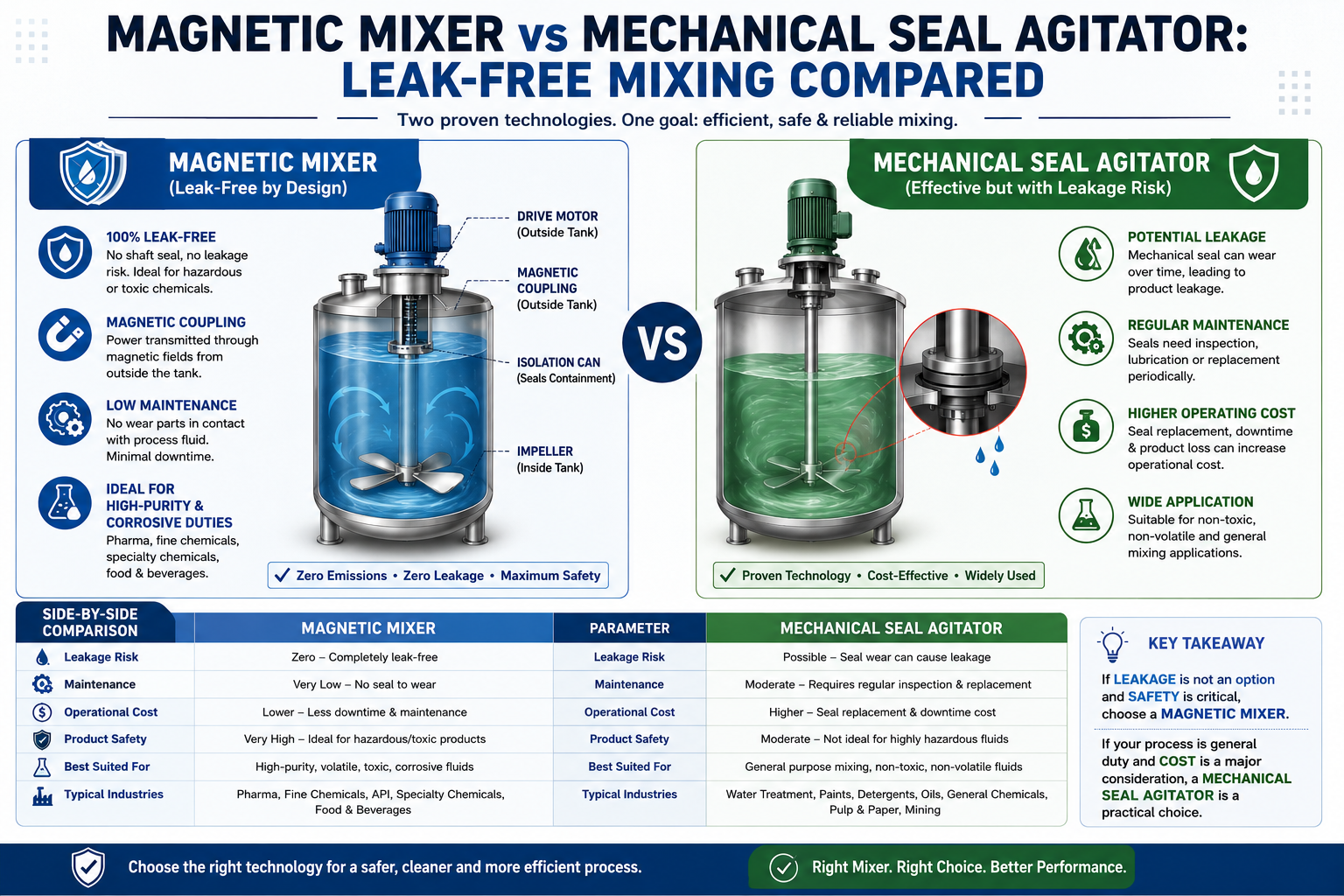
A magnetic mixer — also known as a magnetically coupled mixer or mag-drive agitator — uses the principle of magnetic coupling to transfer torque from an external drive motor to an internal impeller, without any shaft penetrating the vessel wall.
Here's the mechanism in simple terms:
The result is a hermetically sealed mixing system. The vessel is completely closed — no dynamic seals, no shaft penetrations, no leak points. This is what makes magnetic mixers the technology of choice for hazardous, sterile, and ultra-pure applications.
Key Principle
In a magnetic mixer, the drive energy crosses the vessel boundary through magnetic force — not through a physical connection. No opening means no leak pathway.
A mechanical seal agitator uses a conventional rotating shaft that passes through the vessel wall to drive the impeller. The point where the shaft enters the vessel is sealed with a mechanical seal. This seal uses specially designed rotating and stationary parts that are pressed together by springs to prevent leakage.
The mechanical seal is designed to:
Mechanical seals are highly engineered components with a long track record across a vast range of industrial applications. They can be configured in single or double arrangements, with or without barrier fluid, and in materials suited to aggressive chemical environments. However, they are a wear component — they require monitoring, maintenance, and eventual replacement.
Key Distinction
A mechanical seal agitator keeps fluid in through a precision contact seal on a rotating shaft. It is effective and proven, but introduces a dynamic seal that can wear, fail, or leak over time.
This is the core question — and it deserves a direct, nuanced answer rather than a simple win/loss declaration.
Magnetic mixers deliver the closest thing to guaranteed leak-free performance available in agitation technology. Because there is no shaft penetration and no dynamic seal, there is literally no path for process fluid to escape the vessel during normal operation.
This makes them the definitive choice for:
Caveat
Magnetic coupling can decouple if the applied torque exceeds the magnetic coupling force. This "overload decoupling" stops the mixer rather than damaging it — but it also means magnetic mixers are not suitable for very high-viscosity or high-torque applications without careful engineering design.
A properly specified and maintained mechanical seal agitator provides excellent containment across a wide range of applications. The seal failure rate in well-maintained systems is low — but not zero. Leakage risk increases with:
Note
Double mechanical seals with barrier fluid significantly reduce leakage risk by providing a secondary containment layer. However, they also increase system complexity, require barrier fluid management, and add cost. For truly hazardous media, many engineers still prefer the absolute containment of magnetic coupling over the managed-risk approach of even a double mechanical seal.
The maintenance profile of your agitator has a direct impact on production uptime, total cost of ownership, and operational risk — particularly in continuous-process environments.
Magnetic mixers are designed for minimal maintenance. With no dynamic shaft seal to wear, the primary maintenance tasks are limited to:
In many installations, magnetic mixers run for years between meaningful maintenance interventions. For processes where unplanned downtime is extremely costly — such as pharmaceutical batch production or continuous chemical synthesis — this low-maintenance profile is a significant operational advantage.
Mechanical seals are the primary maintenance focus in a conventional agitator. Seal life varies significantly based on process conditions, but typical maintenance activities include:
Seal replacement is not trivial — it typically requires process shutdown, vessel draining, and potentially exposure of technicians to process media. In hazardous chemical environments, this means full PPE protocols and additional safety procedures, adding time and cost to every maintenance event.
Industry Insight
Seal maintenance is the single most common cause of unplanned agitator downtime across chemical and pharmaceutical plants. Reducing seal-related maintenance events directly improves process availability and reduces production losses.
Maintenance Verdict
Magnetic mixers win decisively on long-term maintenance simplicity and reduced downtime risk. When evaluating fluid mixing technologies, maintenance requirements often have a greater impact on lifecycle costs than the initial equipment investment. Mechanical seal agitators require structured, regular seal maintenance that adds to operating cost and exposes technicians to process media.
Selecting between these fluid mixing technologies requires balancing containment requirements, process viscosity, torque demand, and long-term operating costs. Neither magnetic mixers nor mechanical seal agitators are universal solutions. Understanding which technology is better suited to your specific process is the most important part of the selection decision.
Magnetic mixers are the preferred or required technology in several clearly defined application categories:
Pharmaceutical and Biotechnology
Sterile processing, buffer preparation, cell culture media, and API synthesis all require zero contamination risk and CIP/SIP compatibility. Magnetic mixers are the standard in GMP environments.
Hazardous Chemical Processing
Chlorine compounds, concentrated acids, cyanide solutions, and other highly toxic or corrosive media benefit from the absolute containment of a hermetically sealed vessel.
Nuclear Applications
Radioactive fluid handling requires zero-leak containment. Magnetic coupling is the accepted technology for these environments.
Food and Beverage
Hermetic containment prevents external contamination, simplifies cleaning validation, and meets food hygiene standards more easily than shaft-sealed alternatives.
Semiconductor and Electronics
Ultra-pure water and chemical processing for chip manufacturing cannot tolerate any contamination from seal materials or lubricants.
Mechanical seal agitators remain the workhorse technology for a broad range of general and demanding industrial applications:
High-Viscosity Processing
When material viscosity exceeds the torque capacity of available magnetic couplings — typically above 50,000–100,000 cP — mechanical drives are required. Multi-shaft mixing of adhesives, sealants, and polymer compounds typically falls into this category.
Large-Volume Reactors
For large-scale reactors requiring high impeller torque, conventional shaft-driven agitators remain the dominant technology. Magnetic coupling force limits restrict practical scale-up.
High-Temperature and High-Pressure Processing
While magnetic mixers can be engineered for elevated conditions, very high-pressure reactors often favour shaft-driven designs with appropriate seal upgrades.
Budget-Constrained Applications
Where the process media is non-hazardous and reliability requirements are standard, mechanical seal agitators deliver reliable performance at lower capital cost.
General Chemical Processing
For water treatment, general-purpose blending, and non-hazardous batch processes, mechanical seal agitators offer proven, cost-effective performance.
The right choice comes down to matching containment requirements and torque demand to the technology built for them — and confirming the fit with your supplier's process data before committing to a final specification.
| If Your Process Involves... | Choose This |
|---|---|
| Toxic, flammable, or highly corrosive fluids | Magnetic Mixer |
| Sterile or aseptic pharmaceutical manufacturing | Magnetic Mixer |
| Very high viscosity (>100,000 cP) or high solid content | Mechanical Seal Agitator |
| High-torque applications with large impeller loads | Mechanical Seal Agitator |
| Budget-constrained projects with non-hazardous media | Mechanical Seal Agitator |
| CIP/SIP validation requirements (biotech/pharma) | Magnetic Mixer |
| Moderate viscosity, general chemical processing | Either — compare total cost of ownership |
| Radioactive or ultra-pure media (zero contamination) | Magnetic Mixer |
In our experience evaluating mixing applications, the same specification errors appear repeatedly. Avoiding these will save significant cost and complexity downstream.
Magnetic couplings have a defined maximum transmissible torque. If the process requires more torque — due to high viscosity, high impeller speed, or large vessel diameter — the coupling will decouple. Always verify that the maximum operating torque of your process falls comfortably within the coupling's rated capacity, with an appropriate safety margin.
A standard single mechanical seal is not appropriate for strong oxidising acids, halogenated solvents, or other highly corrosive media. Always specify seal face materials, elastomers, and metallurgy based on the actual chemical resistance requirements of your process — not a default catalogue specification.
Selecting the lower capital cost option without modelling total cost of ownership is a common and costly mistake. A mechanical seal agitator that fails twice in its first three years of operation in a hazardous process will almost certainly cost more in total than the magnetic mixer that was ruled out on price.
Process media, concentrations, and throughput requirements often change after initial equipment specification. A magnetic mixer specified at the upper limit of its torque capacity leaves no headroom for future process intensification. Design in margin — particularly for equipment that is difficult or expensive to replace in situ.
Field Insight
The best mixer specifications we review have one thing in common: they start from process hazard analysis, not from equipment catalogues. Define your containment requirement first — then select the technology that meets it.
Experienced process engineers and mixing specialists consistently identify three factors that separate well-engineered mixing system specifications from ones that cause problems.
1. Containment Classification Before Equipment Selection
Before comparing magnetic and mechanical seal options, classify your process media by hazard level — toxic, flammable, corrosive, radioactive, pharmaceutical-grade — and establish the containment standard required by your safety case or regulatory framework. This determines whether a hermetically sealed system is mandatory or optional, which immediately narrows your technology choice.
2. Viscosity and Torque Mapping Across the Full Process Cycle
Viscosity often changes significantly during mixing — particularly in reactive processes, heat-sensitive formulations, or polymerisation reactions. Map viscosity across the full batch cycle, not just at the endpoint. Your mixer must handle the peak torque demand, not just the average.
3. Maintenance Burden as a Design Input
The maintenance implications of your agitator selection have real operational consequences: how often will seals need replacement, who will perform that work, what PPE is required, and what is the procedure if a seal fails unexpectedly at 2 AM during a continuous process? These questions should be part of the specification process — not a surprise during commissioning.
Answers to the most common engineering questions we receive when comparing magnetic mixers and mechanical seal agitators.
Among modern fluid mixing technologies, both magnetic mixers and mechanical seal agitators have established roles in industrial process engineering. The debate between magnetic mixers and mechanical seal agitators is not about which technology is inherently better — it's about which technology is right for your specific process requirements.
The most expensive mixing system is not the one with the highest purchase price. It's the one that fails in service, contaminates a batch, triggers a safety incident, or causes days of unplanned downtime.
Start from your process hazard and performance requirements — not from the equipment catalogue — and the right choice will follow.