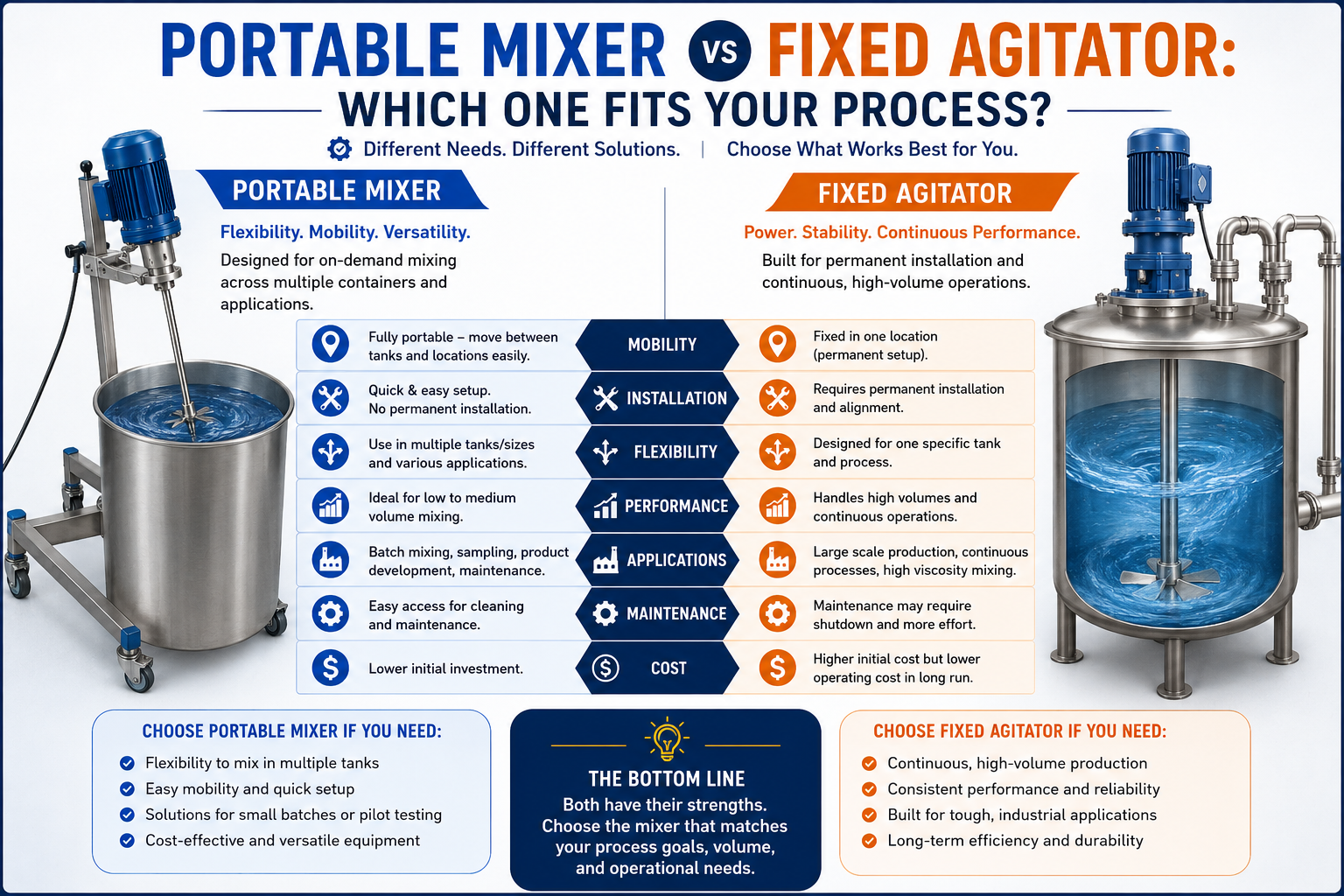
A portable mixer is a movable mixing unit designed to serve multiple tanks, drums, or totes, while a fixed agitator is permanently installed on a dedicated vessel for consistent batch or continuous processing. Choosing between them depends on vessel configuration, production frequency, process duty, and the level of operational flexibility required.
Choosing between a portable mixer and a fixed agitator is not simply a question of mobility—it is a process engineering decision based on how the equipment will be used. Factors such as the number of vessels, batch frequency, fluid properties, operating schedule, and production requirements all influence which solution is more suitable.
Although both are designed to blend liquids, suspend solids, or promote uniform mixing, they differ significantly in how they are installed, operated, and integrated into the process. A portable mixer is intended to be transferred between multiple vessels, whereas a fixed agitator is engineered specifically for one tank and its operating conditions.
This comparison explains the fundamentals of both equipment types, including their construction, typical applications, and operating characteristics, providing the technical foundation needed before comparing their performance, advantages, and limitations.
A portable mixer is a self-contained mixing unit designed to be moved between tanks, drums, totes, or other vessels instead of remaining permanently installed on a single tank.
It enables one mixer to be used across multiple mixing applications, making it suitable for facilities where batch sizes, vessels, or production schedules frequently change.
How portable mixers are built, how they're secured to a vessel, and where they're typically deployed across production environments.
Portable mixers typically consist of an electric or pneumatic motor, a vertical shaft, and an impeller such as a propeller, turbine, or hydrofoil. The mixer is secured using removable mounting arrangements including clamp mounts, bung mounts, bridge mounts, or mounting plates, allowing installation and removal without modifying the vessel.
Depending on the application, shaft length and impeller configuration are selected to match the vessel dimensions and mixing requirements. This flexibility allows the same mixer drive to be used across different container sizes where appropriate.
Portable mixers are commonly used wherever multiple vessels require intermittent mixing rather than dedicated agitation. Typical applications include:
Portable mixers are generally selected for intermittent or batch-based operation. They are most suitable for low- to medium-viscosity fluids where a single mixer can efficiently service multiple vessels throughout the production cycle.
Their portability reduces equipment investment when dedicated agitators are not required for every tank.
A fixed agitator is a permanently installed mixing system engineered for a specific vessel and process. The mixer, shaft, impeller, seal, and drive assembly are selected according to the tank geometry, fluid properties, and process duty, providing consistent mixing performance throughout the equipment's operating life.
Fixed agitators are commonly installed as top-entry, side-entry, or bottom-entry configurations using flanged or nozzle-mounted connections integrated into the vessel.
Because the installation is permanent, the complete assembly—including the gearbox, shaft, bearings, sealing system, and impeller—is engineered specifically for the application's operating conditions.
Fixed agitators are widely used in processes where the same vessel performs the same operation repeatedly or continuously. Common examples include:
Fixed agitators are suitable for both batch and continuous operation, depending on the process requirements.
They can be engineered for a wide range of viscosities, vessel sizes, and mixing objectives, making them the preferred choice where long operating hours, process consistency, and dedicated tank performance are critical.
A side-by-side look at how the two equipment types differ across installation, flexibility, cost, and process fit.
| Parameter | Portable Mixer | Fixed Agitator |
|---|---|---|
| Installation | Clamp, bung, bridge, or plate mount; no permanent tank modification required | Flanged or nozzle-mounted; integrated into the vessel during design or fabrication |
| Mobility | Easily transferred between tanks, drums, or totes | Permanently installed on a dedicated vessel |
| Process Flexibility | Ideal for changing products, batch schedules, or multiple vessel assignments | Best suited to repeatable processes on a dedicated vessel |
| Initial Investment | Lower initial investment; one mixer can serve multiple vessels | Higher initial investment; typically one agitator per vessel |
| Maintenance | Can be removed and serviced away from the tank | Maintenance is generally performed at the installed location |
| Cleaning | Removal provides unobstructed access for manual cleaning or CIP | Cleaning is designed around the installed shaft and impeller using CIP, SIP, or other engineered cleaning methods |
| Tank Compatibility | Adaptable across multiple vessels within its design range | Engineered specifically for one vessel's dimensions and operating conditions |
| Batch Size | Optimized for flexible, variable batch production | Optimized for consistent, repeatable batch or continuous production |
| Mixing Efficiency | Well suited to low- to medium-viscosity fluids and general-purpose blending | Engineered for a broad viscosity range and specific mixing duties |
| Production Capacity | Typically selected for intermittent or moderate-duty operation | Engineered for the required production duty, including continuous operation where applicable |
| Scalability | Expanded by adding mixers to support additional vessels or batches | Expanded by designing larger vessels with appropriately engineered mixing systems |
| Energy Consumption | Determined primarily by process duty and mixing requirements | Determined primarily by process duty and mixing requirements |
| Maintenance Downtime | Downtime can often be minimized by replacing the unit with a spare mixer | Maintenance is tied to the installed equipment and may require process downtime |
| Best Applications | Pilot plants, R&D, drum and tote mixing, multi-product batch operations | Dedicated reactors, process tanks, continuous manufacturing, and process-critical applications |
At a glance: When comparing a portable mixer vs fixed agitator, the decision is rarely about mobility alone. A portable mixer is designed to maximize flexibility by serving multiple vessels and changing production schedules, whereas a fixed agitator is engineered for long-term performance in a dedicated vessel. The right choice depends on process requirements, vessel configuration, production volume, and operational strategy.
How each mixer type is installed, and how that decision ripples into process flexibility, investment, maintenance, and long-term vessel compatibility.
A portable mixer does not require permanent modification to the vessel. It is typically secured using a clamp, bung, bridge support, or mounting plate, allowing it to be installed or relocated quickly without altering the tank.
A fixed agitator, by contrast, is installed through a flanged or nozzle-mounted connection that forms part of the vessel design. Installation is therefore normally planned during tank fabrication or carried out during scheduled maintenance shutdowns.
Mobility is the most obvious difference, but process flexibility is often the more important engineering consideration.
Facilities producing multiple products, changing batch schedules, or using the same vessels for different formulations benefit from portable mixers because a single unit can be transferred wherever mixing is required. In contrast, facilities operating dedicated production vessels—such as resin reactors, adhesive tanks, or continuous process vessels—typically select fixed agitators engineered specifically for that application.
Because one portable mixer can serve multiple vessels, the initial equipment investment can be distributed across several applications, reducing the total number of mixers required within a facility.
A fixed agitator represents a dedicated investment for a specific vessel. Its cost reflects equipment engineered to meet defined process requirements, including shaft design, sealing arrangement, gearbox selection, and operating duty.
Portable mixers can be removed from the vessel and serviced on a maintenance bench, simplifying inspection and repair while avoiding tank entry wherever possible.
Fixed agitators are generally serviced at the installed location. Maintenance involving seals, bearings, or gearboxes may require access to the vessel and, depending on the process, confined-space procedures or scheduled equipment shutdowns.
Removing a portable mixer provides unobstructed vessel access, making manual cleaning or CIP procedures straightforward in facilities producing multiple products where contamination control is important.
Fixed agitators remain installed during cleaning. Rather than being more difficult to clean, they are typically integrated into engineered cleaning systems such as CIP or SIP, while some applications use retractable or lift-up designs to simplify maintenance and sanitation.
Portable mixers can be adapted for multiple vessels within their design range. Factors such as shaft length, impeller diameter, liquid level, and process requirements determine which tanks can be served effectively.
A fixed agitator is engineered specifically for one vessel. Shaft length, impeller geometry, mounting arrangement, and operating conditions are selected for that particular tank and generally cannot be transferred directly to another vessel without redesign.
Portable mixers are well suited to facilities producing variable batch sizes, such as specialty chemical manufacturers, pilot plants, or product development laboratories where vessels and formulations change regularly.
Fixed agitators are typically selected for repeatable production where the same vessel processes a consistent batch size or operates continuously under defined conditions.
How portable mixers and fixed agitators compare on efficiency, capacity, scalability, energy use, and downtime.
Mixing efficiency depends on selecting the correct impeller, rotational speed, power input, tank geometry, and process requirements.
Portable mixers perform effectively in low- to medium-viscosity fluids and general-purpose blending applications across multiple vessels.
Fixed agitators can be engineered for a much wider operating range, including high-viscosity mixing, solid suspension, gas dispersion, or high-shear applications, because the system is designed specifically around the vessel and process duty.
Portable mixers are generally selected for intermittent or moderate-duty production where one mixer serves several vessels throughout the operating cycle.
Fixed agitators are engineered for the required production duty from the outset, with motor rating, gearbox selection, shaft design, and bearing life matched to the application's operating requirements, including continuous operation when required by the process.
Expanding a portable mixing operation typically involves adding additional mixers to support more vessels or increased batch throughput.
Scaling a fixed agitation system usually involves designing a larger vessel—or a new process line—with a mixing system engineered specifically for the increased volume, impeller sizing, and power requirements.
Energy consumption is determined primarily by the required mixing duty rather than whether the equipment is portable or fixed. Factors such as fluid viscosity, impeller diameter, rotational speed, tank geometry, and process objectives have a far greater influence on power consumption than the installation method itself.
Portable mixer downtime can often be minimized by replacing the unit with a spare mixer while maintenance is carried out separately.
Because a fixed agitator forms part of the vessel, maintenance is generally tied to that specific installation. Repairs involving seals, bearings, or drive components may require the associated process to be taken out of service unless a dedicated spare assembly has been planned.
Choose a portable mixer when your process requires flexibility across multiple vessels, varying batch sizes, or temporary production setups. It is typically specified where one mixer needs to support several operations rather than remain permanently installed on a single tank.
When batch volumes range from a few gallons to a few hundred gallons, investing in a dedicated fixed agitator is often unnecessary. A portable mixer, correctly sized for the vessel and mixing duty, provides effective agitation without the additional engineering and installation requirements of a permanent system.
Where several tanks do not require mixing simultaneously, a single portable mixer—or a small fleet of mixers—can be moved between vessels as production schedules demand. This approach improves equipment utilization while avoiding the cost of installing a dedicated agitator on every intermittently used tank.
Pilot-scale operations frequently involve different formulations, vessel sizes, and mixing parameters from one trial to the next. Adjustable mounting options and interchangeable shafts or impellers allow portable mixers to be reconfigured quickly without redesigning the entire mixing system.
Where production lines are commissioned for limited campaigns, seasonal demand, or short-term manufacturing projects, a portable mixer eliminates the need for permanent vessel modifications while providing the required mixing performance throughout the production run.
Chemical dosing tanks used for coagulants, pH adjustment chemicals, disinfectants, or similar process additives generally require intermittent agitation to maintain solution uniformity. A portable mixer matched to the vessel size and fluid characteristics provides an efficient and economical solution without requiring a dedicated agitator at every dosing point.
In water and wastewater treatment facilities, mixing is often required only at specific stages of the treatment process rather than continuously across every vessel. Portable mixers are commonly specified because they can be shared between multiple dosing, preparation, or holding tanks where agitation requirements vary throughout the day.
Research and development environments regularly test multiple formulations, viscosities, and batch sizes within the same laboratory or pilot facility. Portable mixers are particularly well suited to experimental and process development work because they can be moved between vessels without permanent installation.
Contract manufacturers often process different customer formulations using the same production equipment. Portable mixers provide the flexibility to support changing products and production schedules without permanently dedicating a mixer to a single vessel.
In summary, if your process involves changing vessels, multiple formulations, intermittent operation, or pilot-scale production, a portable mixer generally offers the greatest operational flexibility and efficient utilization of mixing equipment.
Talk to an engineer →Choose a fixed agitator when the same vessel performs a dedicated mixing process repeatedly or continuously. It is typically the preferred solution where process consistency, long operating hours, and engineered mixing performance are more important than equipment mobility.
Continuous manufacturing processes require mixing equipment designed for uninterrupted operation. Motors, gearboxes, bearings, shafts, and sealing systems are selected to withstand sustained operating conditions, making fixed agitators the preferred choice for long-duration process duty.
Large reactors generate higher torque requirements, longer shaft lengths, and greater structural loads than portable mounting arrangements are designed to accommodate. Fixed agitators are engineered as part of the vessel, allowing the complete mixing system to safely handle these operating conditions.
Where production volumes are high and consistent, the mixing system must support continuous throughput without requiring equipment relocation between vessels. Fixed agitators are engineered specifically for the vessel and process, ensuring reliable long-term operation.
Many high-viscosity applications—including resins, heavy slurries, polymer solutions, and similar products—require torque levels, gearbox arrangements, and impeller designs that are more effectively achieved using fixed agitators engineered specifically for the process.
Pharmaceutical production frequently demands validated and repeatable mixing conditions for specific products and vessels. Regulatory requirements, including GMP validation and documented process repeatability, generally favour permanently installed mixing systems that remain dedicated to a validated manufacturing process.
Continuous or high-volume food manufacturing often relies on dedicated process vessels producing the same product repeatedly. Fixed agitators support hygienic equipment design and integrate with CIP (clean-in-place) and SIP (sterilize-in-place) systems, helping maintain sanitation and consistent product quality.
Production-scale paint and coating manufacturing typically involves processing consistent batch sizes and viscosity ranges within dedicated vessels. Fixed agitators are engineered specifically for these production requirements rather than mixing systems intended to be shared across multiple tanks.
Petrochemical processes frequently operate under continuous production schedules with demanding process conditions and strict safety requirements. Fixed agitators are engineered as part of the vessel, including appropriate sealing arrangements and hazardous-area considerations, making them suitable for critical process applications.
In summary, if your process is dedicated to a single vessel with consistent production requirements, a fixed agitator typically provides better long-term process integration, repeatable mixing performance, and reliable operation throughout the equipment's service life.
Talk to an engineer →How the two equipment types compare across equipment, installation, civil, maintenance, labor, and total cost of ownership.
| Cost Factor | Portable Mixer | Fixed Agitator |
|---|---|---|
| Equipment Cost | Lower | Higher |
| Installation Cost | Lower | Higher |
| Civil/Structural Cost | Minimal to none | Moderate to significant, depending on vessel size |
| Maintenance Cost | Lower to moderate | Moderate to higher |
| Operating Labor | Higher (repositioning and setup) | Lower (remains installed on the vessel) |
| Total Cost of Ownership | Depends on utilization across multiple vessels | Depends on production volume and operating hours |
A portable mixer generally has a lower purchase price because it is designed to serve multiple vessels using standard configurations. This allows the initial investment to be shared across several applications.
A fixed agitator has a higher upfront cost because it is engineered specifically for one vessel, with the shaft, impeller, gearbox, and sealing system selected to meet defined process requirements rather than functioning as a general-purpose solution.
Portable mixers require minimal installation, typically using a clamp, bung adapter, bridge mount, or mounting plate without modifying the vessel. As a result, commissioning costs are generally lower because no permanent tank modifications are required.
Fixed agitators usually require flanged or nozzle-mounted connections, installation labor, and integration with the vessel during fabrication or scheduled shutdowns, increasing the total installed project cost.
Portable mixers generally require little or no additional civil work because the existing vessel and supporting structure remain unchanged.
Fixed agitators, particularly on larger process vessels or reactors, may require reinforced tank tops, structural supports, foundations, or maintenance platforms. These project-related costs should be considered alongside the equipment cost when evaluating the overall investment.
Portable mixers simplify maintenance because the unit can be removed from the vessel and serviced separately, often minimizing production disruption if a spare mixer is available.
Fixed agitators generally require maintenance to be performed at the installed location, where servicing seals, bearings, or gearboxes may involve vessel access procedures and scheduled downtime.
Energy consumption depends primarily on the mixing duty rather than whether the equipment is portable or fixed. Factors such as impeller diameter, rotational speed, fluid viscosity, batch volume, and process objectives determine the actual power requirement.
Portable mixers are often applied to intermittent, lighter-duty processes and therefore may have lower energy consumption in those applications, while fixed agitators are engineered for more demanding or continuous mixing duties.
Portable mixers require operator time whenever they are repositioned between vessels or production batches. Fixed agitators eliminate this routine setup because they remain permanently installed.
However, portable mixers can often reduce downtime costs by allowing a spare unit to replace the mixer during maintenance, whereas repairs to a fixed agitator are tied directly to the installed vessel and may require longer maintenance windows.
Return on investment depends primarily on equipment utilization rather than purchase price alone.
A portable mixer delivers excellent ROI when it is shared efficiently across multiple vessels or production lines, allowing one unit to perform several mixing duties.
A fixed agitator delivers strong long-term value when supporting continuous or high-volume production, where its higher initial investment is offset by consistent operation, minimal routine setup, and long service life.
Still weighing a portable mixer vs fixed agitator for your process? Fluid Mixing Technologies provides application engineering support to help you select the right equipment for your vessel, batch requirements, and production strategy.
Talk to an engineer →How the two equipment types compare across mixing efficiency, flow pattern, torque, viscosity handling, and process consistency.
| Parameter | Portable Mixer | Fixed Agitator |
|---|---|---|
| Mixing Efficiency | Well suited to general blending applications involving low- to medium-viscosity fluids | Engineered for specific mixing duties across a wider viscosity and shear range |
| Flow Pattern | Typically axial or radial, depending on impeller selection | Engineered to match vessel geometry and process objectives |
| Homogeneity | Suitable where uniform mixing is required but extremely tight repeatability is not critical | Designed to deliver highly consistent batch-to-batch or continuous mixing |
| Torque | Limited by motor size and shaft configuration | Can be engineered for high-torque, low-speed applications |
| RPM | Fixed or limited variable-speed configurations | Selected specifically to match process requirements |
| Viscosity Handling | Best suited to low- and medium-viscosity fluids | Suitable for a broad range of viscosities, including high-viscosity materials |
| Heat Transfer | Typically not integrated with vessel heating or cooling systems | Frequently engineered alongside jacketed or coil-based heat transfer systems |
| Scale-Up Capability | Expanded by adding mixers across additional vessels | Expanded through larger vessels with appropriately engineered mixing systems |
| Process Consistency | Reliable within its operating range, with minor variation possible during repositioning | High repeatability due to permanent installation and fixed operating geometry |
Mixing efficiency depends on selecting the appropriate impeller, rotational speed, power input, and tank geometry for the process—not simply on whether the equipment is portable or fixed.
Portable mixers are well suited to general blending applications, while fixed agitators can be engineered to achieve specific mixing objectives across a broader range of viscosities and process conditions.
Portable mixers typically generate axial or radial flow depending on the impeller selected, providing effective circulation for many general-purpose applications.
Fixed agitators can be engineered specifically for the vessel geometry and process objective, making them better suited to applications requiring controlled solids suspension, gas dispersion, or precise circulation patterns.
Because a fixed agitator maintains the same shaft position, impeller clearance, and mounting geometry throughout its service life, it generally provides greater batch-to-batch consistency.
Portable mixers may experience slight variations in positioning each time they are installed, although this is usually acceptable for standard blending applications.
Higher-viscosity fluids generally require higher torque at lower rotational speeds. Fixed agitators can be engineered with gearboxes and drive systems that deliver a wide range of torque and speed combinations for demanding applications.
Portable mixers are generally configured with standard motor and shaft arrangements appropriate for moderate torque and general-purpose mixing.
Portable mixers perform effectively in low- to medium-viscosity applications where standard motor ratings provide sufficient mixing power.
Fixed agitators are more commonly selected for highly viscous products such as resins, polymer solutions, heavy slurries, and similar materials that require greater torque and specialized impeller designs.
In processes involving heating or cooling, mixing performance directly influences heat transfer efficiency. Fixed agitators are often engineered together with jacketed vessels or internal coils to promote uniform temperature distribution and minimize dead zones.
Portable mixers are generally not designed as integrated components of vessel heat transfer systems.
Expanding a portable mixing operation typically involves adding additional mixers to support more vessels or production lines.
Scaling a fixed agitation system usually requires a larger vessel or a newly engineered mixing system, with impeller size, shaft design, and power requirements recalculated for the increased process volume.
Permanent installation allows a fixed agitator to maintain consistent shaft alignment, impeller clearance, and operating conditions throughout every production cycle. This level of repeatability is particularly valuable in regulated industries and continuous manufacturing.
Portable mixers provide reliable performance within their intended operating range but may exhibit minor setup variations when moved between vessels.
Selecting between a portable mixer and a fixed agitator comes down to evaluating your process against a defined set of engineering and operational variables—not personal preference. The factors below should be assessed together, as each one influences the others.
Tank dimensions Vessel geometry
Vessel diameter, depth, and liquid level determine the shaft length, impeller diameter, and mounting arrangement required. A paint formulator running 200 L batches in standard drums will often find a clamp-mounted portable mixer more than adequate. In contrast, a specialty chemical producer operating a 15,000 L reactor with a non-standard aspect ratio typically requires a fixed agitator engineered specifically for that vessel.
Liquid viscosity Fluid properties
Before selecting equipment, it's important to understand how viscosity affects torque requirements. Thin liquids—such as dilute solutions and most water-based products—can usually be mixed efficiently using a portable mixer with standard motor and shaft ratings. Heavy resins, adhesives, and high-viscosity polymer solutions typically require higher torque and lower operating speeds, making a fixed agitator the more suitable choice for many of these applications.
Density Fluid properties
Fluid density affects the load placed on the shaft, bearings, and mounting structure as batch volume increases. Standard-density liquids are generally manageable with either equipment type, provided they operate within their rated capacities. Higher-density fluids or slurries containing suspended solids place greater mechanical stress on the equipment and should always be evaluated against the manufacturer's performance specifications.
Production volume Throughput
Production volume has a major influence on equipment selection. A paint manufacturer producing 500 L batches across five different tanks often benefits from a portable mixer that can be moved between vessels as needed. By comparison, a chemical plant producing the same 10,000 L formulation continuously typically gains greater efficiency from a permanently installed fixed agitator designed specifically for that production rate.
Batch frequency Operations
How often mixing is required can be just as important as batch size. Intermittent mixing across multiple tanks—for example, a water treatment facility dosing chemicals at several locations throughout the day—takes full advantage of a portable mixer's flexibility. Continuous or high-frequency mixing in the same vessel is where a fixed agitator's dedicated design provides greater operational efficiency.
Mixing objective Process fit
The intended mixing objective—whether blending, solids suspension, dispersion, emulsification, or supporting heat transfer—determines the appropriate impeller design, shaft speed, and flow pattern. General blending applications are typically well suited to a portable mixer's standard configurations. However, processes requiring precise solids suspension, controlled circulation, or high-shear dispersion are generally better served by a fixed agitator engineered for that specific duty.
Available floor space Facility layout
Facility layout also influences equipment selection. Plants with limited floor space, closely positioned vessels, or shared processing areas often benefit from a portable mixer that can be removed when not in use and doesn't require permanent structural clearance. Facilities with dedicated processing lines and sufficient access space can easily accommodate a permanently installed fixed agitator.
Maintenance accessibility Operations
Maintenance requirements should be considered before installation. A portable mixer can usually be unclamped and serviced away from the vessel, making maintenance easier where access is restricted, or confined-space procedures apply. A fixed agitator, on the other hand, requires maintenance planning that may include tank entry, elevated platforms, or scheduled production shutdowns.
Future expansion Planning
Planning for future growth can prevent costly modifications later. If expansion is expected to involve additional vessels or more flexible production schedules, a portable mixer strategy can scale simply by adding more units. If future growth will increase production volume through the same process, investing in a larger vessel and a properly engineered fixed agitator often provides the better long-term solution.
Budget Economics
Budget should always be evaluated as total cost of ownership, not purchase price alone. A portable mixer generally offers lower upfront investment, minimal installation costs, and the flexibility to serve multiple vessels. A fixed agitator requires a higher initial investment—including installation and, in some cases, structural or civil work—but can deliver lower operating costs and greater efficiency over years of continuous production.
The table below provides a quick way to match common process requirements with the equipment type that typically offers the best fit. While every application should be evaluated individually, it serves as a practical starting point for narrowing your options.
| Process requirement | Better fit |
|---|---|
| Multiple tanks | Portable Mixer |
| Pilot plant or R&D | Portable Mixer |
| Variable batch sizes | Portable Mixer |
| Lowest installation cost | Portable Mixer |
| Continuous production | Fixed Agitator |
| High-viscosity materials | Fixed Agitator |
| Heat transfer integration | Fixed Agitator |
| Large reactors | Fixed Agitator |
| Tight batch-to-batch consistency | Fixed Agitator |
Evaluating the factors above together—not in isolation—will help identify the equipment that delivers reliable performance, operational efficiency, and long-term value. The more boxes checked in one column, the stronger the case for that option.
Portable mixers serve industries where mixing demand is intermittent, batch sizes vary, or the same equipment needs to move across multiple vessels rather than stay dedicated to one. The industries below share these operating patterns, even though the specific fluids and objectives differ widely.
| Industry | Typical portable mixer applications |
|---|---|
| Chemical Processing | Batch blending, intermediate preparation |
| Paints & Coatings | Pigment dispersion, resin mixing |
| Adhesives | Polymer blending, small test batches |
| Ink | Color mixing, short-run formulations |
| Food Processing | Sauces, syrups, beverage concentrates, seasoning blends |
| Cosmetics | Creams, lotions, gels |
| Textile | Dye preparation, sizing agents |
| Agriculture | Fertilizer and pesticide mixing |
| Water Treatment | Alum, PAC, polymer, sodium hypochlorite, lime slurry dosing |
| Specialty Chemicals | Pilot batches, catalysts, specialty polymer intermediates |
Portable mixers are widely used in chemical processing for blending small-to-medium batches of specialty formulations or mixing intermediates across several tanks. Their portability lets one unit serve multiple vessels rather than requiring a dedicated agitator on every tank a facility operates.
During product development and small-batch production, portable mixers move easily between test batches as formulators try different color and resin combinations in a single day. Dedicated fixed agitators are typically reserved for full production-scale runs once a formulation is finalized.
Portable mixers are commonly used in adhesive manufacturing for preparing small test batches and short production runs across drums and totes. Since adhesive viscosity and cure characteristics vary by formulation, a portable mixer sized to the batch at hand offers the flexibility this stage of production requires.
Ink production, particularly for specialty or short-run print jobs, often involves smaller batch volumes mixed in drums rather than large dedicated tanks. Portable mixers suit this pattern well, especially where colorants and viscosities change from one run to the next.
Portable mixers are commonly used in food and beverage operations for syrups, sauces, beverage concentrates, seasoning blends, and ingredient premixes — typically in totes or smaller tanks where production volume doesn't justify a dedicated agitator on every vessel. Larger continuous food lines, by contrast, generally shift toward fixed agitators, covered in the earlier selection guide.
Cosmetic and personal care formulation frequently involves small, varied batches — creams, lotions, and specialty blends — each with different viscosities and mixing requirements. Portable mixers allow formulators to move between these batches without dedicating a separate agitator to each product line.
Textile processing facilities use portable mixers for preparing dye solutions, sizing agents, or finishing chemicals in smaller batches, often across multiple prep tanks feeding different production lines. The intermittent nature of this dosing work makes portability more practical than permanent installation at each point.
Agricultural operations preparing fertilizer solutions, pesticide mixes, or nutrient blends typically need mixing only at specific intervals rather than continuously. A portable mixer suits tank-to-tank use on farms or at distribution facilities where the same unit services multiple mixing points as needed.
Water and wastewater facilities commonly use portable mixers for dosing and preparation tanks handling alum, polyaluminum chloride (PAC), polymer, sodium hypochlorite, and lime slurry — chemicals where agitation demand is intermittent and distributed across several dosing points rather than continuous in any single tank.
Specialty chemical producers — manufacturing low-volume, high-value formulations such as pharmaceutical intermediates, catalysts, and specialty polymers — deal with frequent product changeovers and variable batch sizes. A portable mixer supports this operating pattern without the capital cost of dedicating a fixed agitator to every product variant.
Even when a portable mixer is the right category of equipment for the job, selecting the wrong specification within that category can lead to inadequate mixing, premature failure, or equipment that doesn't match the process as it evolves.
Choosing based only on motor HP Sizing
Why it's a mistake: Motor horsepower is often treated as the single deciding spec, when mixing performance actually depends on torque, shaft speed, and impeller design working together with fluid viscosity. Impact: A high-HP motor paired with the wrong impeller can still under-mix a viscous fluid, wasting the extra power without improving results. How to avoid it: Size the mixer against torque and shaft speed requirements for the specific fluid and process objective, not motor HP in isolation.
Ignoring impeller design Impeller selection
Why it's a mistake: Impeller type — propeller, turbine, or hydrofoil — determines the flow pattern the mixer generates, and different flow patterns suit different objectives. Impact: A propeller optimized for general blending won't perform well for solids suspension, and a turbine chosen for high-shear dispersion may be unnecessary and inefficient for simple homogenization. How to avoid it: Match impeller type to the mixing objective — blending, suspension, or dispersion — before finalizing the rest of the specification.
Incorrect shaft length Mechanical design
Why it's a mistake: Shaft length is sometimes estimated rather than calculated against actual liquid depth and vessel geometry. Impact: A shaft that's too short won't reach the mixing zone, leaving stagnant fluid near the tank bottom. A shaft that's too long relative to its diameter can flex or vibrate under load, reducing efficiency and accelerating wear on seals and bearings. How to avoid it: Calculate shaft length against actual liquid depth and verify it against the shaft's diameter-to-length ratio for structural stability, rather than assuming a standard length will fit.
Wrong mounting arrangement Installation
Why it's a mistake: Clamp mounts, bung mounts, bridge mounts, and plate mounts each suit different vessel types and rim configurations, and the choice is sometimes made based on availability rather than fit. Impact: A mount not suited to the vessel — for example, a clamp mount on a rim that can't support the resulting torque load — can lead to instability, vibration, or the mixer working loose during operation. How to avoid it: Match the mounting type to the vessel's rim, opening, or bung configuration, and confirm it can support the torque generated at full operating speed.
Ignoring tank geometry Vessel fit
Why it's a mistake: Even when the mixer itself is correctly specified for the fluid, it can still be mismatched to the vessel — off-center mounting on an irregularly shaped tank, insufficient clearance from baffles or internal fittings, or a vessel depth-to-diameter ratio that creates dead zones the mixer wasn't positioned to reach. Impact: The result is inadequate mixing or uneven blending, even though the mixer's motor, shaft, and impeller are all correctly rated for the fluid. How to avoid it: Evaluate the mixer's positioning against the tank's actual shape, internal fittings, and liquid depth — not just its rated capacity for the fluid.
Underestimating viscosity Fluid properties
Why it's a mistake: Viscosity is sometimes assessed only at room temperature or at the start of a batch, without accounting for how it changes as the process progresses or as temperature shifts — a resin that thickens as it cures, or a solution whose viscosity rises sharply once it cools from a heated mixing stage. Impact: A mixer sized for the initial, lower viscosity may stall or overload as the batch thickens or cools. How to avoid it: Size the mixer against the highest viscosity expected during the process — including the effect of temperature change — not just the starting condition.
Ignoring future production expansion Planning
Why it's a mistake: A portable mixer is sometimes selected strictly for today's batch size, without considering reasonably likely growth. Impact: Replacing an undersized unit shortly after installation adds cost that proper planning would have avoided. How to avoid it: Factor in anticipated batch size or frequency increases when specifying the mixer, rather than sizing strictly to current requirements.
Selecting the wrong RPM Speed selection
Why it's a mistake: RPM is sometimes set at a standard default rather than matched to the fluid and mixing objective. Impact: Running a mixer at too high an RPM for the fluid and vessel can cause excessive turbulence, air entrainment, splashing, or shear damage to sensitive formulations. Running it too slow can leave the batch inadequately mixed or create stagnant zones. How to avoid it: Select RPM based on the fluid's viscosity and the mixing objective — high shear and dispersion applications typically need higher RPM, while gentle blending of shear-sensitive materials needs lower RPM.
Selecting the right portable mixer isn't about choosing the largest motor or the highest speed — it's about matching the mixer to the fluid, vessel, and process requirements. Fluid Mixing Technologies provides application engineering support to help you avoid these common mistakes and improve mixing efficiency, extend equipment life, and reduce long-term operating costs.
Talk to an engineer →Common questions about choosing, sizing, and maintaining portable mixers and fixed agitators.
A portable mixer is used to blend, suspend, disperse, or agitate liquids in tanks, drums, and IBC totes without permanent installation. It's commonly used for batch processing, chemical preparation, product formulation, pilot-scale production, and any application where one mixer needs to serve multiple vessels.
Only within certain limits. A portable mixer can replace a fixed agitator where batch sizes are moderate, fluid viscosity is low to medium, and mixing demand is intermittent rather than continuous. It generally cannot replace a fixed agitator in high-torque, high-viscosity, or continuous production applications, where the fixed unit's dedicated engineering—including shaft loading, seal design, and drive capacity—is designed for sustained operation.
Neither is inherently better—it depends on the chemical process. Portable mixers are well suited to chemical dosing, intermediate blending, and small-to-medium batch production across multiple vessels. Fixed agitators are better suited to continuous reactions, high-viscosity chemicals, and processes requiring consistent, repeatable mixing in a dedicated tank.
Portable mixers can be used on larger tanks within their design range, but very large vessels typically require the higher torque, longer shaft support, and structural mounting that only a fixed agitator can provide. Tank size should always be evaluated alongside fluid viscosity, mixing objectives, and production requirements rather than in isolation.
The right portable mixer is selected by evaluating:
Considering these factors together helps ensure efficient mixing, reliable performance, and long-term value.
Portable mixers are widely used across industries where batch sizes vary, mixing demand is intermittent, or one mixer needs to serve multiple vessels. Common industries include:
Portable mixers generally require less maintenance than fixed agitators because they can be removed from the vessel and serviced without extensive downtime. Routine maintenance typically includes inspecting bearings, seals, couplings, impellers, and mounting hardware, while service intervals depend on operating hours, fluid properties, and the severity of the application.
Choosing between a portable mixer and a fixed agitator isn't about selecting the more powerful piece of equipment—it's about choosing the solution that best matches your process requirements. Factors such as tank size and geometry, fluid viscosity and density, production volume, batch frequency, mixing objectives, operational flexibility, maintenance accessibility, and future expansion plans all influence the right decision.
Fluid Mixing Technologies (FMT) works closely with customers to evaluate tank geometry, fluid properties, viscosity, production goals, and process requirements before recommending the most suitable mixing solution. Whether you need a portable mixer for flexible batch operations or a fixed agitator for continuous production, our engineering team can help you select equipment that delivers reliable, efficient, and long-lasting performance.
Contact Fluid Mixing Technologies today to discuss your application and receive expert guidance on choosing the right mixing solution for your process.
Talk to an engineer →