A simple, practical comparison of two commonly used emulsification technologies to help you choose the right equipment for your product, process, and production needs.
Walk into any emulsification facility, whether it's producing a pharmaceutical cream, a salad dressing, or a polymer dispersion, and you'll find a fundamental piece of equipment at the heart of the operation. But which equipment you choose matters more than most formulators initially realize.
The two most commonly compared technologies are the rotor-stator mixer and the high-speed disperser (HSD). Both systems represent important categories within modern fluid mixing technologies, but they use very different principles to process materials. Understanding these differences is critical when selecting equipment for emulsification and process performance.
On the surface, they look similar: both involve a spinning element inside a vessel. In real-world use, they work in completely different ways, produce different results, and are suitable for different applications.
Choosing the wrong one leads to poor droplet-size distribution, unstable emulsions, wasted energy, and costly reformulation. This guide gives you the technical grounding to make the right call upfront.
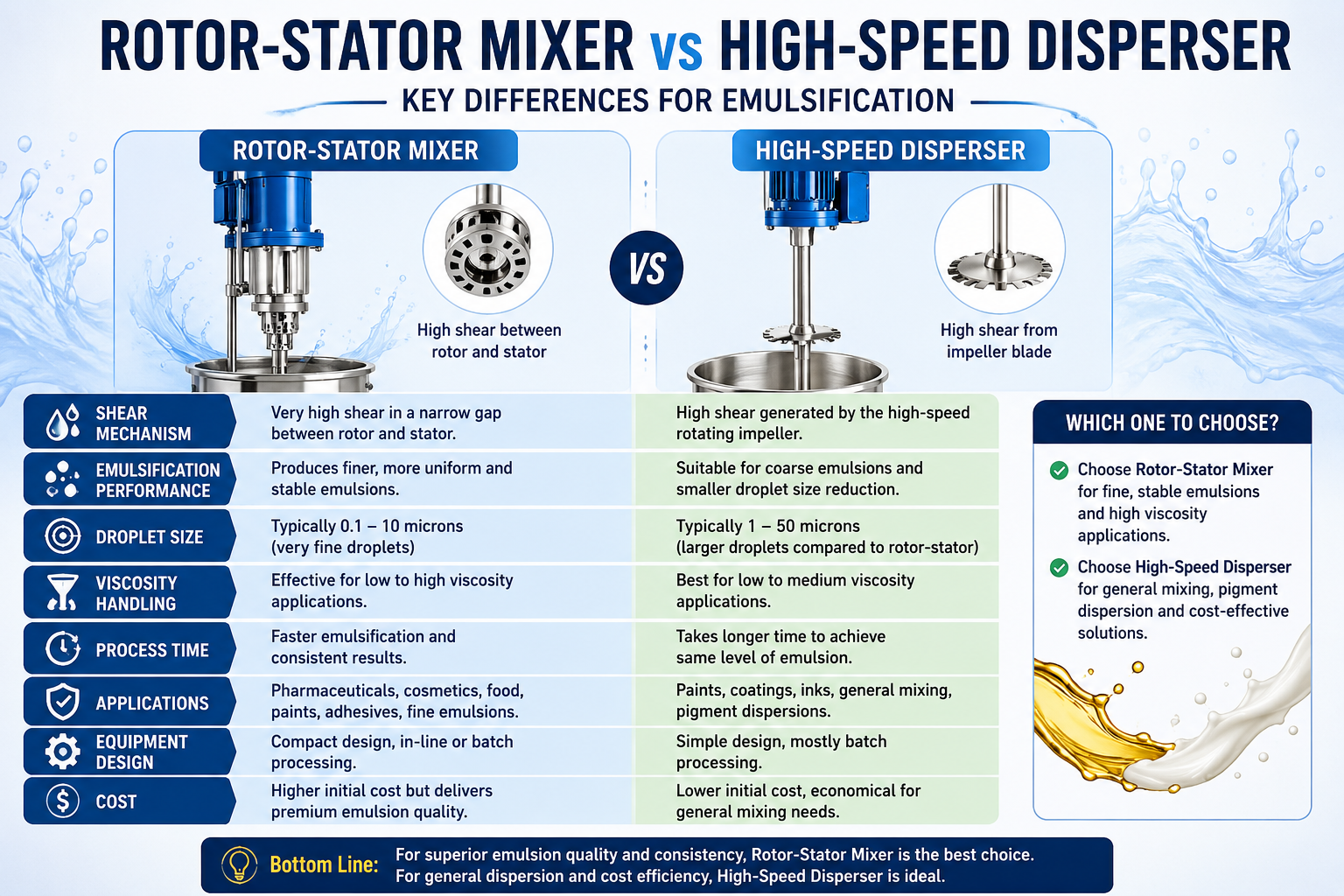
A quick side-by-side look at how rotor-stator mixers and high-speed dispersers differ on the metrics that matter most for emulsification.
| Parameter | Rotor-Stator Mixer | High-Speed Disperser |
|---|---|---|
| Droplet Size | 1–5 µm | 10–100 µm (coarse) |
| Shear Rate | 20,000–100,000 s⁻¹ | 1,000–10,000 s⁻¹ |
| Typical Use | Fine emulsions, nanoemulsions | Dispersion, pre-mixing |
Before comparing the equipment, it helps to understand what emulsification actually demands from a mixer.
Emulsification is the process of dispersing one immiscible liquid (typically oil) into another (typically water) as fine droplets. Achieving a stable emulsion requires two things:
The mixing device controls how much mechanical energy is delivered. Across industrial fluid mixing technologies, the way energy is transferred into the fluid directly affects droplet size, stability, and overall product quality — how efficiently it reaches the droplets, and whether the resulting size distribution is narrow enough for product stability. These criteria directly determine which technology is appropriate.
Key principle: The goal isn't the fastest mixing — it's the most controlled and repeatable energy input that produces a stable droplet population matched to your product specification.
A rotor-stator mixer uses a high-speed rotor spinning inside a close-tolerance stationary stator. The gap between the two, often as small as 0.1–1.0 mm, is where the processing happens. Fluid is drawn into the center, accelerated radially outward, and subjected to intense mechanical and hydraulic shear as it passes through the stator slots.
Three forces act simultaneously on the fluid in the rotor-stator gap:
Rotor tip speeds typically run at 10–50 m/s, generating shear rates in the range of 20,000–100,000 s⁻¹, orders of magnitude higher than standard agitation.
Typical applications of rotor-stator mixers
A high-speed disperser, sometimes called a dissolver, turbine mixer, or Cowles-type disperser, uses a serrated or toothed disc blade rotating at high RPM inside an open vessel. Unlike a rotor-stator, there is no close-tolerance gap and no stator wall. The energy is delivered through turbulent fluid motion across the entire tank. Among industrial fluid mixing technologies, high-speed dispersers are widely used where bulk circulation, powder incorporation, and material dispersion are more important than ultra-fine emulsification.
The disc blade creates two distinct flow zones:
Typical applications of high-speed dispersers
Advantages vs. limitations
Advantages
Limitations
Fluid Mixing Technologies supplies high-speed dispersers engineered for reliable bulk circulation, powder incorporation, and pre-mixing across paints, adhesives, and polymer processing applications.
Explore solutions →Here is where the technical distinctions become critical for emulsification decisions. The two technologies differ across every major process parameter.
| Parameter | Rotor-Stator Mixer | High-Speed Disperser |
|---|---|---|
| Shear Rate | 20,000–100,000 s⁻¹ | 1,000–10,000 s⁻¹ |
| Droplet Size | 1–5 µm | 10–100 µm (coarse) |
| Size Distribution | Narrow (uniform PDI) | Broad (variable PDI) |
| Energy Density | 10⁸–10⁹ W/m³ | 10⁵–10⁷ W/m³ |
| Viscosity Range | 1–100,000 mPa·s | 1–50,000 mPa·s |
| Shear Sensitivity | Controlled (esp. inline) | Less controlled |
| Continuous Operation | Yes — inline configuration | Rarely |
| Scale-Up Predictability | High (defined geometry) | Moderate (vessel-dependent) |
| Heat Generation | Moderate (managed via jacket) | Lower in open vessel |
| Primary Use | Fine emulsification, nanoemulsions | Pre-mixing, dispersion |
| Typical Industries | Pharma, cosmetics, food | Paints, adhesives, polymers |
| Capital Cost | Higher | Lower |
This is the most consequential difference. Comparing these fluid mixing technologies requires more than looking at RPM values alone. Shear rate, energy density, and flow patterns often determine actual process performance.
Rotor-stator mixers concentrate energy into an extremely small processing zone, the rotor-stator gap. This creates localized energy densities of 10⁸–10⁹ W/m³, which is necessary for breaking droplets into the sub-micron range.
High-speed dispersers spread energy across a larger volume of material. The blade tip region is energetic, but most of the vessel receives only moderate turbulence. Energy density is typically 10⁵–10⁷ W/m³, sufficient for wetting and deagglomeration, but not for producing fine emulsions reliably.
A key metric for emulsion quality is the polydispersity index (PDI) — how narrow or broad the droplet size distribution is. Rotor-stator mixers produce significantly narrower distributions because every element of fluid is processed through the same defined gap geometry.
High-speed dispersers produce broader distributions because different parts of the batch receive different amounts of shear depending on proximity to the blade. This inconsistency directly affects emulsion stability and shelf life.
Rotor-stator mixers handle high-viscosity formulations well because the fluid is forcibly drawn through the gap by the pumping action of the rotor. They can emulsify thick creams, gels, and pastes that a disperser might struggle to circulate.
High-speed dispersers depend on free fluid circulation within the vessel. As viscosity increases, circulation slows, and an increasing portion of the batch never reaches the high-shear zone near the blade. This limits effective emulsification in high-viscosity systems unless paired with additional agitation.
High-intensity mixing generates heat. In rotor-stator systems, because energy is concentrated in a small zone, local temperature rises can be significantly managed using jacketed vessels, cooling coils, or intermittent processing cycles.
High-speed dispersers spread the energy input more broadly, leading to gentler overall temperature rise. For products containing heat-sensitive actives (vitamins, proteins, certain APIs), this lower thermal load can be an operational advantage, though it comes at the cost of emulsification quality.
Scale-up predictability is a major engineering advantage of rotor-stator technology. Because the shear is applied within a geometrically defined gap, performance can be scaled by adjusting flow rate, rotor speed, gap width, and stator geometry — all measurable, reproducible parameters.
High-speed dispersers scale less predictably. The relationship between tip speed and emulsion quality changes as vessel geometry changes, making it harder to guarantee the same droplet distribution when moving from a 10L bench batch to a 1,000L production vessel.
Fluid Mixing Technologies helps formulators match the right emulsification technology to their product — from lab-scale rotor-stator development to fully scaled, continuous inline production.
Explore solutions →The decision comes down to four factors: required droplet size, product viscosity, production scale, and whether emulsification quality is the primary goal or one step in a larger process.
How the choice between rotor-stator and high-speed disperser plays out across key industries.
Rotor-stator mixers — particularly inline units — are the standard for pharmaceutical emulsification. Products like parenteral lipid emulsions, ophthalmic drops, and oral suspensions require droplet sizes below 1 µm with tight polydispersity, and the process must be fully validatable. High-speed dispersers may be used for preliminary blending of excipients, but not for the emulsification step itself.
Most cosmetic emulsions — lotions, creams, serums, sunscreens — are produced using batch rotor-stator mixers in jacketed vessels. The equipment allows precise texture control and is compatible with the wide viscosity range seen in cosmetic formulations. High-speed dispersers are frequently used as pre-mix agitators in larger vessels before the rotor-stator processing step.
Food emulsification requirements vary enormously. A salad dressing may tolerate droplets in the 5–15 µm range (achievable with an HSD), while a coffee creamer, plant-based milk, or infant formula requires the fine distribution and long-term stability that only a rotor-stator or homogenizer can deliver. Food manufacturers often have both technologies on-site for different product lines.
This is the natural home of the high-speed disperser. Pigment wetting, resin dissolution, and binder integration are primarily dispersion and deagglomeration tasks — not strict emulsification. Rotor-stator mixers are rarely the primary piece of equipment here, though they may be used for specific products requiring a finer particle size.
Not sure which technology fits your product? Fluid Mixing Technologies provides application engineering support to help you select the right emulsification equipment for your formulation, viscosity, and production scale.
Talk to an engineer →Work through the following pitfalls before finalizing your equipment selection — they account for the majority of avoidable emulsification failures and rework.
Using an HSD where a rotor-stator is needed Shear mismatch
If your emulsion shows poor stability, phase separation, or inconsistent texture, the shear level from a disperser may simply be insufficient — no amount of longer mixing time compensates for inadequate shear rate.
Running a rotor-stator without appropriate cooling Thermal control
Prolonged rotor-stator processing at high speeds significantly heats the product. Always incorporate temperature monitoring and manage heat via jacketed vessels or processing cycles.
Ignoring surfactant concentration when switching equipment Formulation fit
A higher-shear mixer generates new droplet surfaces faster, which requires your emulsifier to adsorb faster. If emulsifier concentration isn't optimized for the new equipment, emulsion stability can actually worsen.
Scaling from bench HSD to production rotor-stator without reformulation Scale-up validation
These are different processing environments. Always validate the emulsion's physical properties (droplet size, zeta potential, viscosity) at each scale transition.
Choosing the cheapest option without a lifecycle cost analysis Economics
A rotor-stator's higher upfront cost is often recovered rapidly through reduced rework, fewer stability failures, and lower batch cycle times at production scale.
Both rotor-stator mixers and high-speed dispersers are valuable tools — but they are not interchangeable for emulsification. The differences in shear mechanism, energy density, and droplet size capability are fundamental, not marginal.
Still unsure which technology fits your process? Fluid Mixing Technologies provides application engineering support to help you select the right emulsification equipment for your formulation, viscosity, and production scale.
Talk to an engineer →