

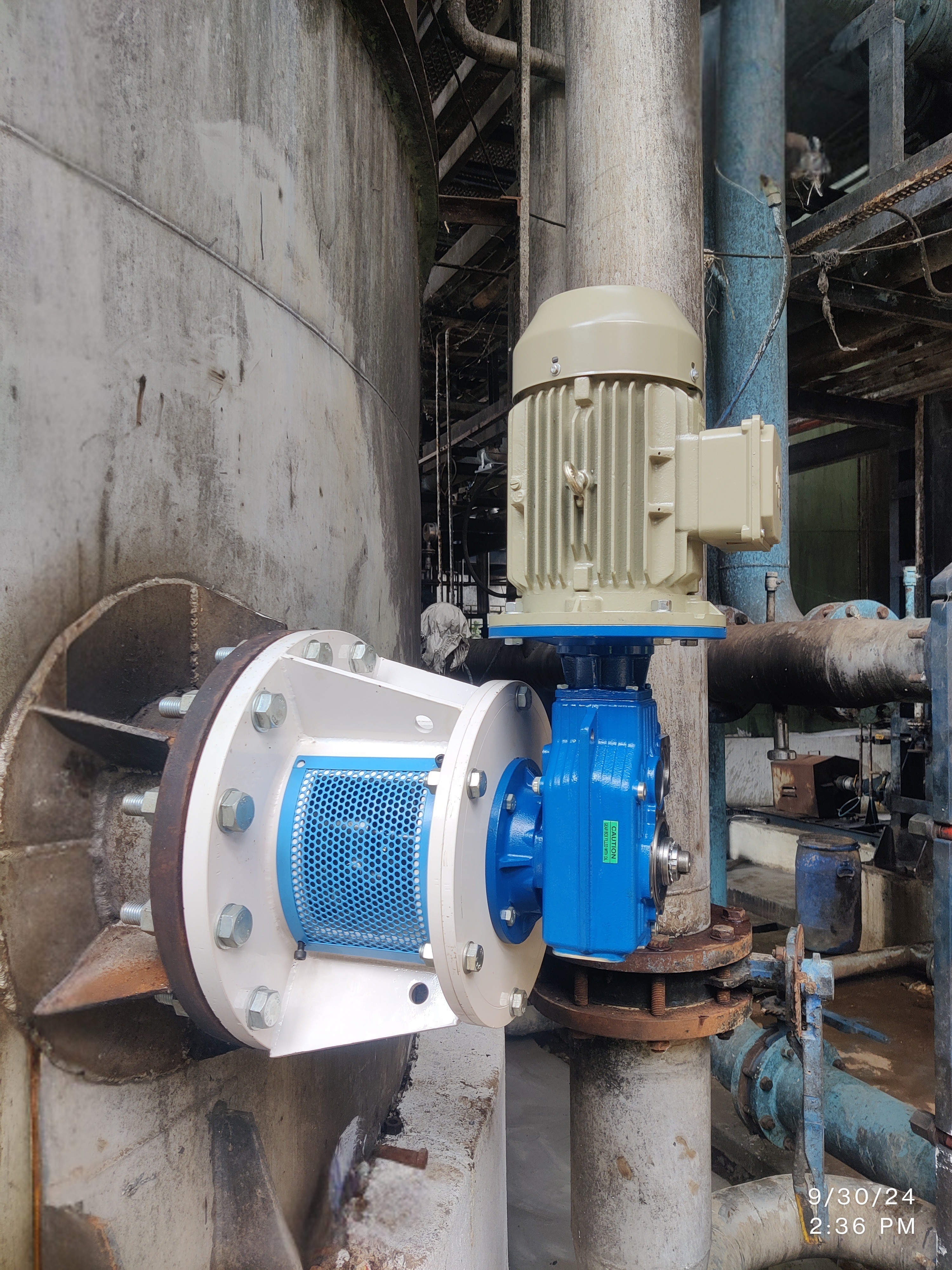
Side entry mixers are widely used in large industrial storage tanks to maintain circulation, prevent sedimentation, and ensure product consistency. As a Side Entry Mixer Manufacturer in India, Fluid Mixing Technologies designs robust tank agitators engineered for continuous industrial mixing, efficient fluid circulation, and reliable performance across demanding process industries.
Side Entry Mixer Manufacturer in India | Industrial Tank Agitators & Mixing Systems
Fluid Mixing Technologies designs industrial side-entry agitators that deliver stable mixing performance, even in large vessels handling high-volume liquids, slurry systems, and fibrous materials.
Our mixers are engineered for long-term reliability in continuous industrial environments where process consistency and operational stability are critical.
What Is a Side-Entry Mixer, and Where Is It Used?
- A side-entry mixer is an industrial agitation system installed on the side wall of a storage tank or process vessel.
- The mixer shaft extends horizontally into the tank and rotates an impeller that generates strong axial flow circulation.
- This circulation keeps materials suspended, prevents sediment buildup, and ensures uniform mixing throughout the tank.
- Side entry mixers are typically used in large industrial tanks ranging from 50 KL to 500 KL, where installing a top-entry mixer may not be practical due to tank height or structural constraints.
Typical applications include:
- Maintaining suspension in storage tanks
- Preventing sludge formation
- Circulating liquids in large vessels
- Mixing chemical solutions
- Handling fibrous or slurry media
Because these mixers produce high liquid circulation with relatively low power consumption, they are widely used in industrial tank mixing systems across multiple process industries.
Why Industrial Plants Use Side Entry Mixers
Large storage tanks often face mixing challenges due to their volume and geometry. Without proper agitation, liquids can stratify, solids can settle, and temperature gradients can develop.
Side-entry mixers address these issues by generating powerful horizontal flow patterns that move fluid across the entire tank.
Key benefits include:
Efficient Circulation in Large Tanks
Side-entry mixers provide strong axial pumping capacity that circulates liquids throughout the vessel, preventing dead zones.
Lower Installation Complexity
Mounting the mixer on the tank wall eliminates the need for large structural supports required by top-entry mixers.
Energy Efficient Mixing
Hydrofoil impellers are designed to move large liquid volumes with minimal energy consumption.
Reduced Maintenance Downtime
Side-mounted mixers can be serviced without removing tank roofs or accessing the vessel interior.
Continuous Industrial Duty
Heavy-duty drive systems allow reliable 24/7 operation in demanding industrial environments.
These advantages make side-entry mixers a preferred industrial mixer equipment solution for large storage tanks.
What are the different Industrial Mixing Equipment manufactured by Fluid Mixing Technologies?
Fluid Mixing Technologies designs and manufactures multiple types of industrial agitation systems used across process industries.
Side Entry Mixer Manufacturer in India
Our side-entry mixers are designed for large tanks requiring high circulation capacity and reliable mixing performance.
These mixers are widely used in storage tanks handling liquids, slurries, and fibrous materials.
Side Entry Agitator Manufacturer in India
Side-entry agitators provide axial-flow mixing for large industrial vessels where horizontal circulation is required to prevent sedimentation and maintain product uniformity.
Bottom Entry Mixer Manufacturer in India
Bottom entry mixers are typically installed in smaller process vessels where vertical agitation and controlled mixing are required for blending, homogenization, or reactor applications.
Industrial Tank Agitator Manufacturer in India
Industrial tank agitators manufactured by Fluid Mixing Technologies support mixing applications across chemical processing, water treatment, food production, and pharmaceutical manufacturing.
Applications Across Process Industries
Industrial mixing requirements vary significantly depending on fluid properties, tank size, and process objectives. Our side entry mixers are engineered to handle a wide range of industrial applications.
Oil and Gas Mixing Systems
In petroleum storage tanks, mixers are used to maintain uniform product composition and prevent sludge accumulation.
Side entry mixers help:
- circulate crude oil in storage tanks
- prevent sediment formation
- improve heat transfer during heating processes
- maintain uniform product quality
The strong axial flow generated by the impeller ensures effective mixing even in large tanks.
Fertiliser and Agrochemical Processing
Liquid fertilizers and agrochemical formulations often contain dissolved salts and suspended solids.
Without proper agitation, these materials can settle and affect product consistency.
Side entry mixers maintain suspension in:
- liquid fertilizer tanks
- agrochemical blending systems
- nutrient storage vessels
Their high-solids slurry handling capability ensures stable mixing performance.
Paints and Coatings Manufacturing
Paint formulations require controlled mixing to maintain pigment suspension and prevent separation.
Side entry mixers are used in:
- pigment storage tanks
- solvent storage vesselss
- intermediate formulation tanks
The hydrofoil impeller produces smooth circulation while minimizing excessive shear.
Water and Wastewater Treatment
Municipal and industrial treatment plants rely on mixing systems to maintain chemical distribution and prevent sludge settling.
Side entry mixers are commonly installed in:
- equalization tanks
- sludge storage tanks
- chemical dosing tanks
- wastewater treatment basins
Their energy-efficient design allows continuous operation in treatment facilities.
Plastics and Polymer Processing
Polymer production processes require consistent mixing of additives and resins.
Side entry mixers help maintain uniformity in:
- resin storage tanks
- additive blending vessels
- polymer slurry systems
These mixers support stable mixing conditions in large process tanks.
Electric Vehicle Battery Materials
Battery manufacturing involves slurry systems containing metal oxides and conductive additives.
Proper mixing is essential to prevent particle settling and maintain consistent slurry properties.
Side entry mixers are used in:
- precursor chemical tanks
- slurry storage vessels
- material preparation tanks
Their design supports high-solids mixing and uniform dispersion.
Paper and Pulp Processing
The paper and pulp industry presents unique mixing challenges due to fibrous materials.
Side entry mixers are used in pulp storage tanks to maintain fiber suspension and prevent settling.
Design considerations include:
- large hydrofoil impellers
- high torque drive systems
- robust shafts capable of handling fibrous loads
These mixers maintain continuous circulation, ensuring consistent feed to downstream paper production processes.
Explain the technical specifications of the Side Entry Mixer
Below are typical specifications for the side-entry mixer manufactured by Fluid Mixing Technologies.
| Specification | Details |
|---|---|
| Motor Power | 7.5 HP |
| Capacity | 1000 L |
| Tank Capacity | 50 KL |
| Shaft Speed | 300 RPM |
| Usage/Application | Industrial |
| Impeller Type | Hydrofoil |
| Wet Parts Material | SS316 |
| Mounting Type | Side Entry |
| Material | Stainless Steel |
| Surface Finish | Mirror |
| Voltage | 415 V |
| Frequency | 50 Hz |
| Vessel Pressure | Atmospheric |
| Phase | Three Phase |
| Volume Range | 50–500 KL |
| Motor Make | Crompton |
| Propeller Blade Number | 3 |
| Blade Diameter | 600 mm |
| Shaft Diameter | 50 mm |
What are the side- entry mixer engineering design features?
Fluid Mixing Technologies designs mixing systems using practical process engineering principles.
Key design features include:
Axial Flow Hydrofoil Impeller
The hydrofoil impeller generates high pumping capacity while minimizing energy consumption.
Heavy-Duty Shaft Construction
A 50 mm shaft diameter ensures structural stability for large tank mixing applications.
High Torque Drive Systems
Industrial motors provide sufficient torque for mixing slurry systems and fibrous media.
Mechanical Seal or Gland Packing Options
Sealing systems are selected based on process requirements to ensure leak prevention and durability.
VFD Compatible Drives
Variable frequency drives allow operators to control mixing intensity based on process conditions.
Continuous Industrial Operation
All mixers are engineered for 24/7 industrial duty cycles.
Engineering Considerations in Side Entry Mixer Design
Effective tank mixing requires careful evaluation of several engineering parameters.
Impeller Pumping Capacity
The pumping capacity determines how effectively the mixer circulates liquid throughout the tank.
Power Number
The power number helps determine energy consumption relative to impeller speed and size.
Flow Pattern
Side entry mixers generate axial flow patterns that promote strong tank circulation.
Tank Diameter Ratio
Impeller diameter is selected relative to tank size to ensure adequate pumping capacity.
Baffle Requirement
In certain tanks, baffles may be used to improve mixing efficiency and reduce vortex formation.
Shear Sensitivity
Hydrofoil impellers are preferred for shear-sensitive products because they provide gentle but effective mixing.
How to Select the Right Side Entry Mixer for Your Tank
Choosing the correct mixer configuration requires understanding the process conditions and tank geometry.
Tank Diameter
Larger tanks require impellers capable of moving higher liquid volumes.
Fluid Viscosity
Higher viscosity fluids require increased torque and larger impeller sizes.
Solid Suspension Requirement
If solids are present, the mixer must generate sufficient circulation to prevent sedimentation.
Mixing Objective
Typical mixing objectives include:
- circulation
- suspension
- homogenization
- temperature equalization
Impeller Diameter
Impeller size must be optimized to achieve proper circulation within the vessel.
Tank Geometry
Tank height, diameter, and internal structures influence mixer placement and performance.
What is the difference between Side Entry and Bottom Entry Mixers?
Different mixing configurations serve different industrial needs.
| Parameter | Side Entry Mixer | Bottom Entry Mixer |
|---|---|---|
| Mounting | Side wall of the tank | Bottom of the vessel |
| Tank Size | Large storage tanks | Small to medium process vessels |
| Flow Pattern | Horizontal axial flow | Vertical circulation |
| Maintenance | Accessible externally | Requires vessel access |
Fluid Mixing Technologies designs both side-entry mixers and bottom-entry mixers depending on process requirements.
Common Industrial Mixing Challenges:
Many storage tanks experience mixing problems due to inadequate agitation systems.
Common issues include:
Sedimentation
Heavy particles settle at the tank bottom and affect product consistency.
Poor Circulation
Large tanks may develop stagnant zones without proper agitation.
Fiber Settling
Fibrous materials such as pulp may accumulate in certain tank areas.
Energy Inefficiency
Improper mixer selection can increase energy consumption.
Dead Zones
Inactive regions inside the tank reduce mixing effectiveness.
Side entry mixers solve these problems by generating strong axial circulation across the entire vessel volume.
Serving Pune and Industrial Regions Across India
As a Side Entry Mixer Manufacturer in Pune, Fluid Mixing Technologies supports manufacturing facilities across major industrial regions, including:
- Pune Industrial Area
- Pimpri-Chinchwad (PCMC)
- Chakan MIDC
- Talegaon Industrial Zone
- Ranjangaon Industrial Area
Our mixing systems are supplied to manufacturing plants, EPC contractors, and process industries across India.
Frequently Asked Questions About Side Entry Mixers
Side entry mixers generate strong axial circulation inside large tanks, preventing sedimentation and ensuring uniform product mixing.
Side entry agitators are typically used in large storage tanks where top entry mixers would require excessively long shafts.
Side entry mixers are commonly used in tanks above 50 KL capacity, especially where continuous circulation is required.
They are widely used in oil and gas, water treatment, fertilizer manufacturing, pulp processing, chemical production, and polymer industries.
Discuss Your Industrial Mixing Requirement
Selecting the correct tank mixing system requires careful evaluation of tank size, fluid properties, and process objectives.
You can:
- Request detailed technical specifications
Fluid Mixing Technologies provides practical engineering support to help industrial facilities implement reliable and efficient industrial agitation systems.