
Mineral processing moves ore as slurry, and almost every tank in the circuit has to keep solids in suspension: conditioning and feed tanks, leach and adsorption tanks, precipitation and neutralisation tanks, and tailings and transfer tanks. If the solids settle, the tank loses working volume, the pumps draw uneven slurry and restarting after a stop becomes difficult. The particles are hard, so impellers and shafts wear, and leach liquors add acid or chloride corrosion.
We size each agitator for its solids. Particle size, density and concentration decide the speed needed just to keep them suspended, and running no faster than that limits both wear and power. Reagent and flocculant make-up tanks have a different duty: dissolving powders, or diluting polymer without breaking it down. For precipitation and crystallization steps, see crystallizer agitators.
For rare-earth and other metal recovery plants, see agitators for rare earth and hydrometallurgy.
Reference job
5 KL filtrate tank agitator for a rare-earth processing plant, Visakhapatnam (2024)
| Duty | Keeps a sodium chloride filtrate solution (SG about 1.2, water-thin, ambient) circulating in a 5 KL tank |
|---|---|
| Tank | Ø1650 × 2500 mm straight side, supplied by the client; agitator designed to its drawing |
| Impellers | Two AF-2 high-efficiency hydrofoils, Ø850 mm, and a Ø500 mm kicker near the bottom |
| Drive | 1.5 kW 4-pole IE3 motor with a parallel helical gearbox, about 86 rpm |
| Shaft | Ø60 mm, about 2.7 m long, with a steady bearing and a rigid removable coupling |
| Materials | Wetted parts SS316L, drive frame painted MS |
| Checks | Ultrasonic-tested shaft bar, balancing report, material certificates and a quality dossier with the dispatch |
Typical mixing duties
- Ore slurry conditioning and feed tanks
- Leach and adsorption tanks
- Precipitation and neutralisation tanks
- Reagent and flocculant make-up
- Thickener feed and transfer tanks
- Tailings and slurry holding tanks
What we design for
- Impellers sized for just-suspended solids, to limit wear and power
- Wear allowance or wear-resistant wetted parts
- Materials checked against acid and chloride leach liquors
- Drives and bearings for continuous duty and for restarting after a stop
Equipment for mining and minerals
 Leach and CIL/CIP tank agitatorsGold, uranium and rare-earth leach tanks
Flotation conditioner agitatorsZinc, lead, copper and phosphate plants
 Slurry and reagent tank agitatorsUnderflow, lime milk, flocculant and xanthate
Precipitation tank agitatorsAlumina and rare-earth precipitators
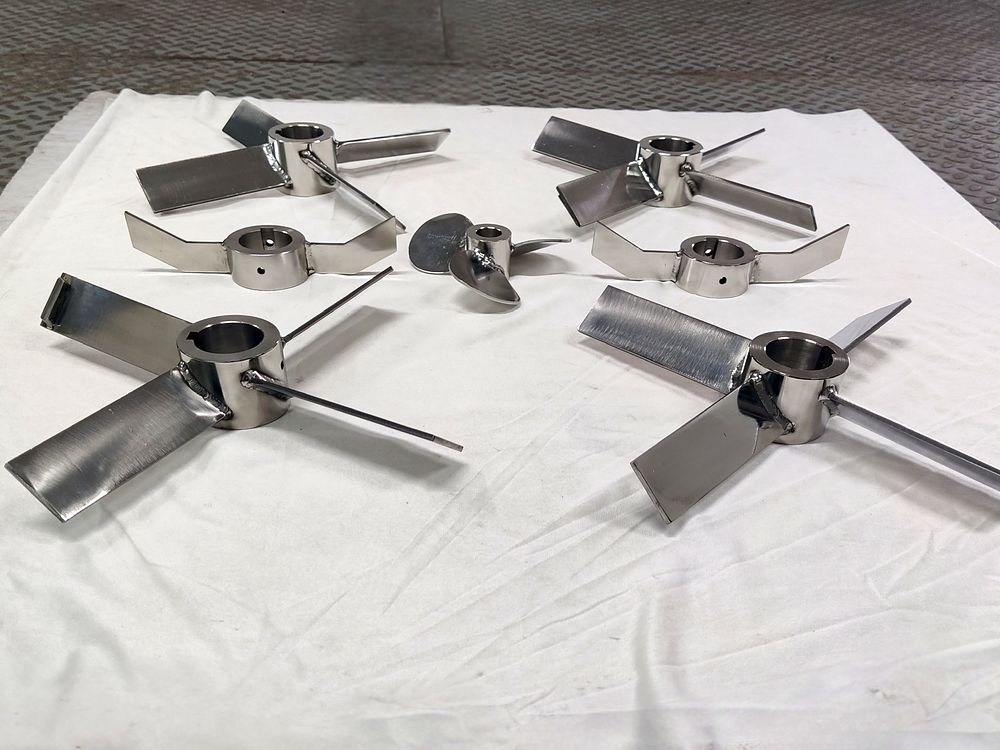 ImpellersReplacement and upgrade impellers
 Mixing tanks and agitated vesselsVessels supplied with the agitator