
In a leach train the slurry flows from tank to tank while the metal goes into solution. In CIL (carbon in leach) and CIP (carbon in pulp) circuits, activated carbon is mixed into the slurry to adsorb the dissolved gold, so the agitator must also keep the carbon moving without grinding it. Gold, uranium and rare-earth plants use the same tank-and-agitator layout with different chemistry.
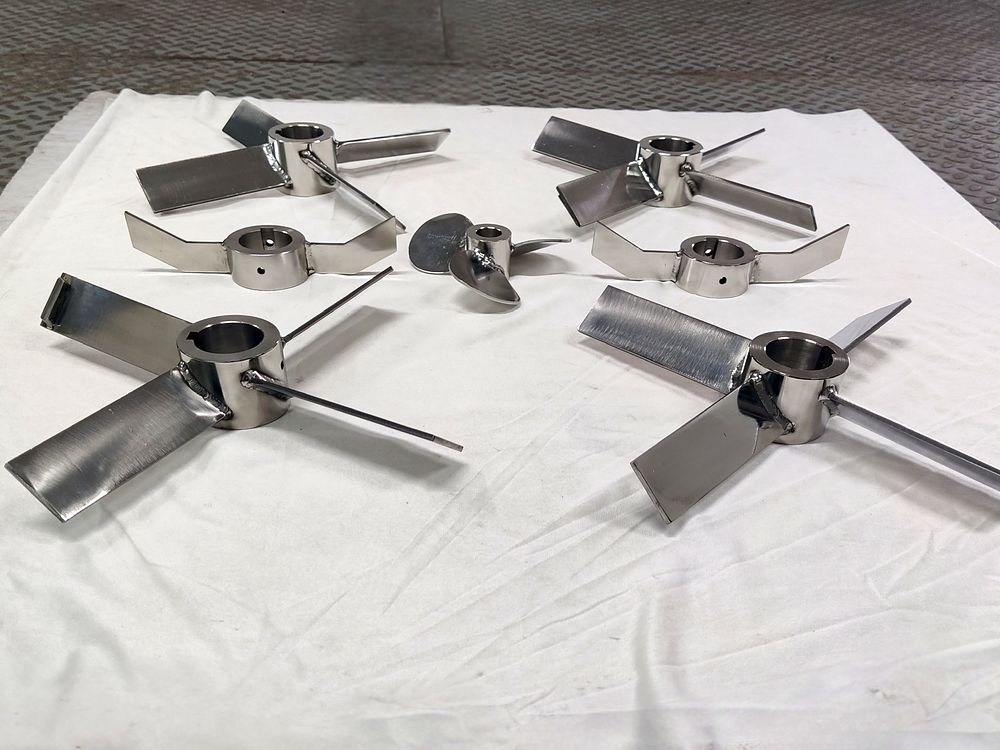
We size each agitator from the tank, the slurry density, the solids size and the duty: the lowest speed that keeps the bottom clear, with high-efficiency hydrofoils that move a lot of slurry for their power and are gentle on carbon. The drive is a heavy-duty industrial gearbox and motor chosen for the torque and continuous service, like the 90 kW drive shown. Blades carry a wear allowance and can be bolted, so they are changed without replacing the whole impeller.
We build agitators for tanks up to 500 KL, for your tanks or with the tanks. Screens, carbon handling and process design stay with your consultant; we work to their data sheets. Worn impellers, shafts, gearboxes and seals for existing leach agitators: see agitator spares and replacement.
Where it is used
- Gold CIL and CIP tanks
- Leach tanks with cyanide, acid or chloride liquors
- Uranium leach tanks
- Rare-earth leach and dissolution tanks
- Pre-leach conditioning tanks
- Slurry holding tanks ahead of the leach train
How FMT builds it
| Drive | Heavy-duty industrial gearbox and motor for torque and 24-hour service, on a beam or tank-top mounting |
|---|---|
| Impellers | One or two high-efficiency hydrofoils at low speed; pitched blade turbines where the duty suits |
| Wear | Wear allowance on the blades; bolted blades where replacement in place is planned |
| Shaft | Solid shaft checked for stress, deflection and critical speed; steady bearing where the shaft is long |
| Materials | Carbon steel or stainless steel wetted parts, chosen for the leach chemistry; other alloys on request |
| Restart | Drive and impeller position chosen for restarting in settled slurry where stops are expected |
The red lines show how the impeller moves the liquid. Every FMT unit is sized for its own vessel, product and duty, so yours is drawn for your tank in the offer.
Send your vessel for a drawing


What we need to size it
- Tank diameter, height and working level, with a drawing if you have one
- Slurry density, solids percentage, particle size and the solids specific gravity
- Leach chemistry and temperature (cyanide, acid or chloride)
- Carbon concentration, for CIL and CIP tanks
- Whether the agitator must restart in settled slurry
- Power supply and the mounting: beam, tank top or existing structure