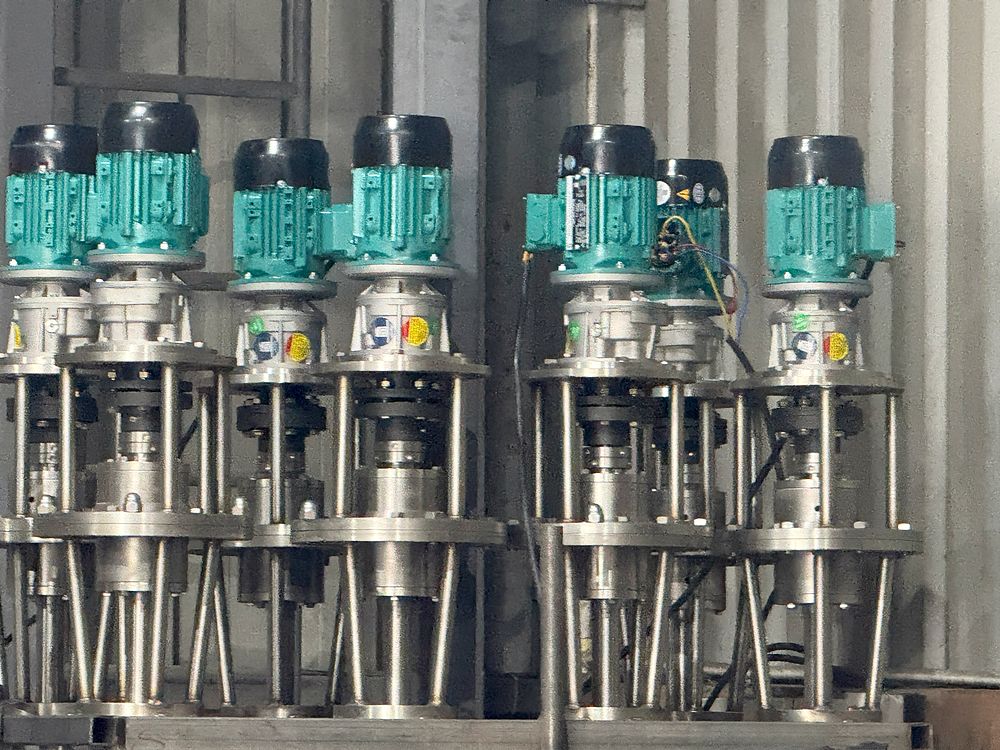
A bottom entry agitator is chosen when the top of the vessel is crowded or must stay clear, when mixing has to continue down to a very low level, or when a short, stiff shaft is preferred to a long one. The shaft is short, so deflection and critical speed are rarely the limit; the shaft seal is.
The seal works under the full liquid head and is in contact with the product, so we choose it with care: usually a single or double mechanical seal suited to the product, the temperature and the cleaning regime, with the drain and flush connections it needs. The vessel needs legs or a skirt with enough clearance below for the drive and for seal maintenance; we give you that clearance with the offer.
Where it is used
- Vessels whose top head is crowded with nozzles
- Mixing down to a low level while draining
- Small and medium batch vessels
- Bottom-mounted high shear duty (see below)
How FMT builds it
| Drive | Geared motor or motor with gearbox, mounted under the vessel |
|---|---|
| Impeller | Pitched blade, hydrofoil or a low-clearance impeller near the bottom head |
| Shaft seal | Single or double mechanical seal, with drain and flush connections |
| Wetted parts | SS 304 or SS 316 / 316L; other materials on request |
| Mounting | Flanged to a nozzle on the bottom head |
The red lines show how the impeller moves the liquid. Every FMT unit is sized for its own vessel, product and duty, so yours is drawn for your tank in the offer.
Send your vessel for a drawingWhat we need to size it
- Vessel diameter, straight-side height and bottom shape (dished, conical, flat)
- Working volume and liquid level range, including the lowest level at which mixing must continue
- Product: density, viscosity at operating temperature, solids content and particle size
- What the agitator must do: blend, suspend, disperse, dissolve, heat or cool, react
- Operating and design pressure and temperature, and whether the vessel is open or closed
- Preferred materials, seal type, motor make, power supply and hazardous-area classification