

A reactor has to do more than hold the batch. It must keep the reactants mixed while they react, move the heat of reaction in or out fast enough to hold the temperature, contain pressure, vacuum and vapour, and drain and clean between batches. These depend on each other: the agitator decides how well heat passes through the wall, and the heat duty decides the jacket and the agitator speed.
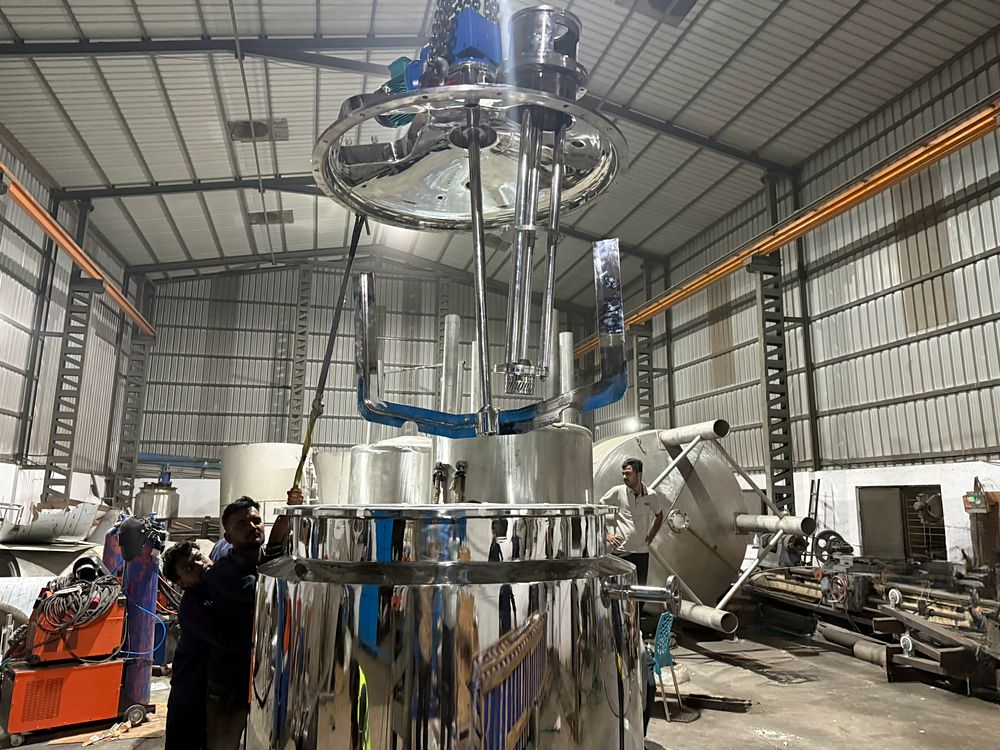
FMT designs the agitator and the vessel together and builds both in its own works in Pune. We size the impellers for the hardest point in the batch, choose a jacket, limpet coil or dimple jacket for the heating and cooling media, and select the shaft seal for the pressure and the vapour. Each reactor is supplied with its general arrangement drawing, agitator datasheet and inspection records. For reactions with hydrogen or other gases under pressure, see hydrogenators and high pressure reactors.
Where it is used
- Batch chemical reactions
- Resin, polymer and adhesive manufacture
- Pharma intermediates
- Agrochemical and dye intermediates
- Neutralisation, esterification and condensation
- Dissolving, digestion and holding at temperature
How FMT builds it
| Design code | ASME Section VIII or PED on request |
|---|---|
| Vessel | Vertical, with dished top and bottom heads, on legs, lugs or a skirt |
| Materials | SS 304 and SS 316 / 316L; SS 317L, 904L and nickel alloys on request |
| Heating / cooling | Conventional jacket, limpet (half-pipe) coil or dimple jacket; internal coils where more area is needed |
| Media | Steam, thermic oil or hot water for heating; cooling water or chilled water for cooling |
| Agitator | Top entry, with hydrofoil, pitched blade, turbine, anchor or anchor-with-turbine impellers |
| Shaft seal | Single or double mechanical seal for closed and pressurised reactors |
| Fittings | Manhole, sight glass, process nozzles, temperature and pressure gauges, bottom outlet |
| Finish | Mirror or matt internal finish; insulation and cladding over the jacket on request |
The red lines show how the impeller moves the liquid. Every FMT unit is sized for its own vessel, product and duty, so yours is drawn for your tank in the offer.
Send your vessel for a drawing

What we need to size it
- Working volume, or the batch size and its density
- Design pressure and vacuum, and the design temperature
- The reaction: reactants, solvents, viscosity through the batch, and any solids or gas
- Heat to be added or removed, and the heating and cooling media available
- Material of construction, or the chemistry so that we can propose one
- Nozzle list and instruments, if you have them
- Seal preference, motor make, power supply and hazardous-area classification


