
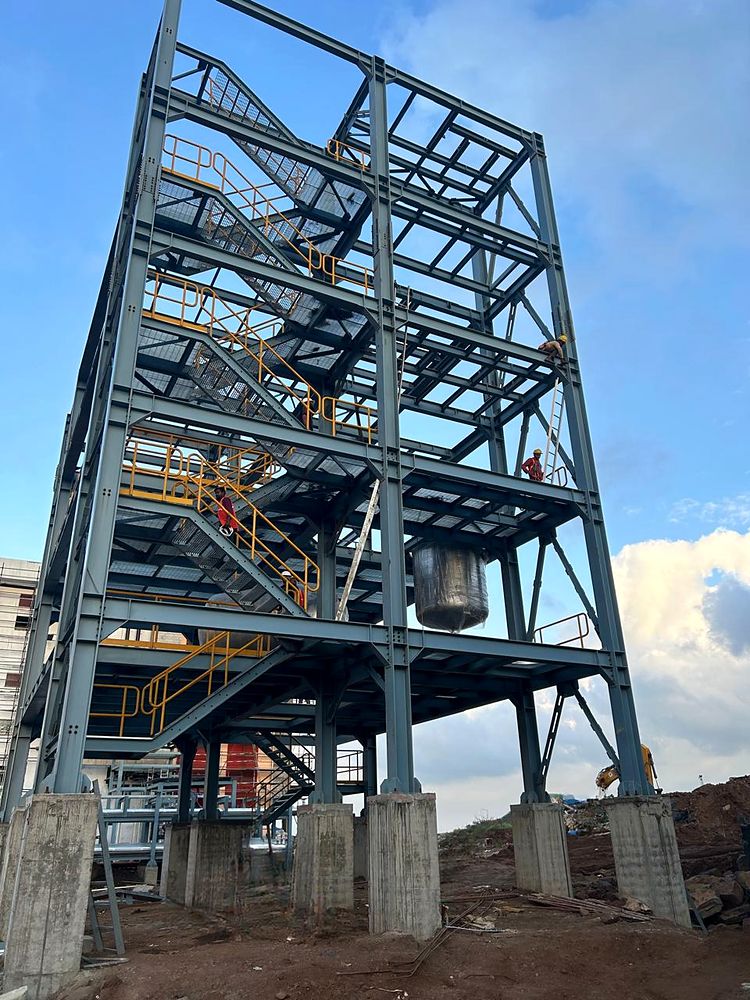
A process plant is a sequence of steps: charging, reacting or mixing, heating and cooling, separating, storing and transferring. The agitated vessels and reactors are usually the steps that decide product quality and batch time, so they are where we start. We size each vessel and its agitator for the process, and then the heat exchangers, pumps, piping and structure that connect them.
We build the reactors, vessels, agitators and heat exchangers in our own works in Pune and assemble as much as possible before dispatch, as skid-mounted modules where the plant allows it. The project covers the process flow diagram and P&ID, layout, fabrication, erection and commissioning. For plants that blend to a recipe, see chemical blending plants.
Where it is used
- Specialty and fine chemical plants
- Resin, polymer and emulsion plants
- Pharma intermediate plants
- Food and edible oil processing
- Pilot and scale-up plants
- Expansions of existing plants
How FMT builds it
| Reaction and mixing | Reactors and agitated vessels, jacketed or limpet coil, with agitators sized for each step |
|---|---|
| Heat transfer | Shell and tube heat exchangers, condensers and jackets for heating and cooling |
| Storage | Raw material and product tanks, and a tank farm where needed |
| Transfer | Pumps, piping, valves and filters between steps |
| Structure | Plant structure with platforms, or skid-mounted modules |
| Hazardous areas | Flameproof motors and equipment where the area classification requires it |
| Controls | From manual operation to automatic batch control |
| Project scope | PFD and P&ID, layout, fabrication, erection and commissioning |
The red lines show how the impeller moves the liquid. Every FMT unit is sized for its own vessel, product and duty, so yours is drawn for your tank in the offer.
Send your vessel for a drawing


What we need to size it
- The process: steps, batch or continuous, and a description of each step
- Products and raw materials, with their properties and hazards
- Batch size and batches a day, or the hourly output
- Temperatures, pressures and heating or cooling needed at each step
- Utilities available: steam, cooling water, chilled water, nitrogen, power
- Site location, hazardous-area classification and the space available


