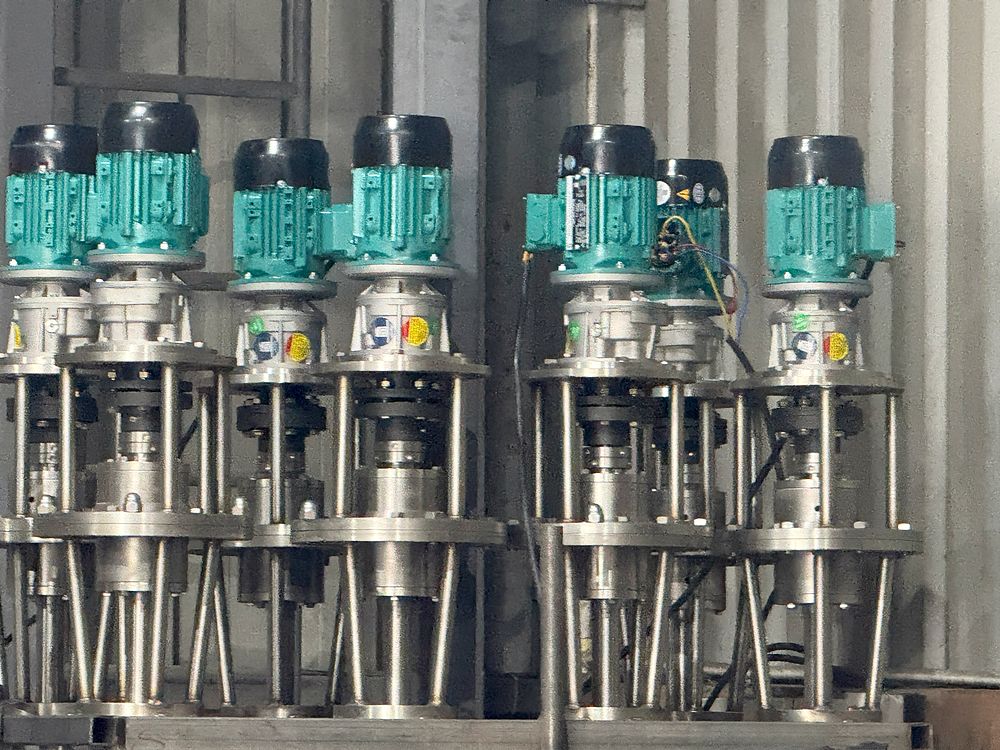

Most blending plants make a family of products from liquid and powder raw materials, to a recipe, in batches. Product quality comes down to three things: the right quantity of each ingredient, mixing until the batch is uniform, and keeping one product from contaminating the next. Tank sizes, pumps, piping and controls all follow from the product list, the batch size and the daily output.
The blend tank and its agitator decide whether the product comes out right, so that is where we start. The agitator is sized for the most demanding product on the list, whether that is a thin solvent blend, a viscous polymer solution or a powder that has to be dispersed. We then engineer the plant around it: process flow diagram and P&ID, layout, fabrication, erection and commissioning. For production and drilling chemicals, see oilfield chemical blending plants.
Where it is used
- Specialty and performance chemicals
- Oilfield production and drilling chemicals
- Toll and contract blending of many products
- Water treatment chemicals
- Agrochemical formulations
- Lubricants, additives and industrial fluids
How FMT builds it
| Raw materials | Storage tanks for bulk liquids, drum and IBC unloading, and charging points for powders and additives |
|---|---|
| Dosing | Load cells, flow meters or calibrated tanks, chosen for the accuracy each recipe needs |
| Blend tanks | Agitated vessels in SS 304, SS 316 / 316L or carbon steel, jacketed where the product needs heating or cooling |
| Agitation | Top entry agitators, high speed dispersers or rotor-stator mixers, sized for the most demanding product |
| Transfer | Pumps, filters and piping between tanks, laid out to drain fully between products |
| Finished product | Storage tanks and drum or IBC filling |
| Hazardous areas | Flameproof motors where the area classification requires it; air-motor agitators where electric drives are not allowed |
| Layout | Plant on a structure at site, or skid-mounted modules for faster installation and later expansion |
| Controls | From manual operation to automatic batch control with stored recipes, dosing and agitator speed control |
| Project scope | PFD and P&ID, layout, fabrication, erection and commissioning |
The red lines show how the impeller moves the liquid. Every FMT unit is sized for its own vessel, product and duty, so yours is drawn for your tank in the offer.
Send your vessel for a drawing


What we need to size it
- The products to be made, with a typical recipe for each: ingredients and proportions
- Batch size and number of batches a day, or the daily output
- How raw materials arrive: road tanker, drums, IBCs or bags
- Viscosity, density and flash point of the main raw materials and products
- Hazardous-area classification of the site and the utilities available
- How the finished product leaves the plant: in bulk, IBCs or drums
- Site location, ambient conditions and the space available