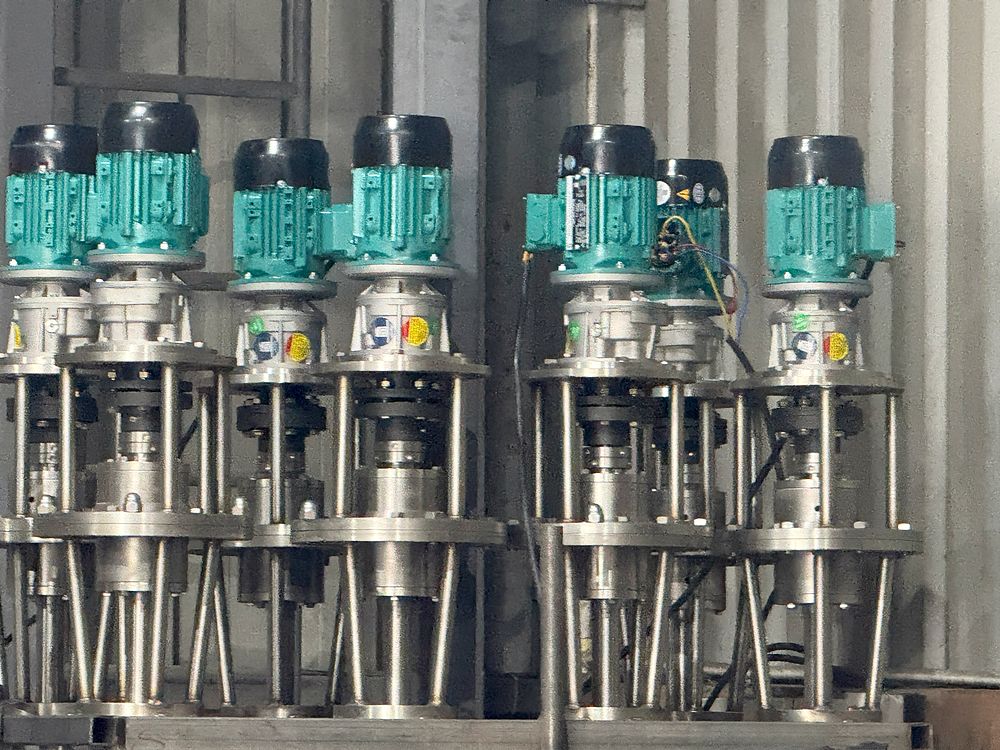

Viscous products defeat single agitators. A disperser on its own leaves a stagnant layer at the wall; an anchor on its own moves the batch but cannot disperse powders. A multi-shaft mixer combines them: the anchor, often with scrapers, keeps material moving off the wall and into the path of the high speed tool, which wets powders and breaks agglomerates.
Each shaft has its own drive and speed control, so the process can be run as the batch thickens. Jacketed vessels use the anchor scraping to improve heat transfer at the wall. We design the vessel, the agitators and the drives together, because the clearances between them decide how well the mixer works.
Where it is used
- Adhesives and sealants
- Putty, pastes and gels
- Viscous coatings and primers
- Creams and ointments
How FMT builds it
| Slow shaft | Anchor, with scrapers where needed, on a geared drive |
|---|---|
| Fast shaft | Saw-tooth disperser or rotor-stator head on a variable speed drive |
| Vessel | Open or closed, jacketed for heating or cooling |
| Wetted parts | SS 304 or SS 316 |
The red lines show how the impeller moves the liquid. Every FMT unit is sized for its own vessel, product and duty, so yours is drawn for your tank in the offer.
Send your vessel for a drawingWhat we need to size it
- Vessel diameter, straight-side height and bottom shape (dished, conical, flat)
- Working volume and liquid level range, including the lowest level at which mixing must continue
- Product: density, viscosity at operating temperature, solids content and particle size
- What the agitator must do: blend, suspend, disperse, dissolve, heat or cool, react
- Operating and design pressure and temperature, and whether the vessel is open or closed
- Preferred materials, seal type, motor make, power supply and hazardous-area classification