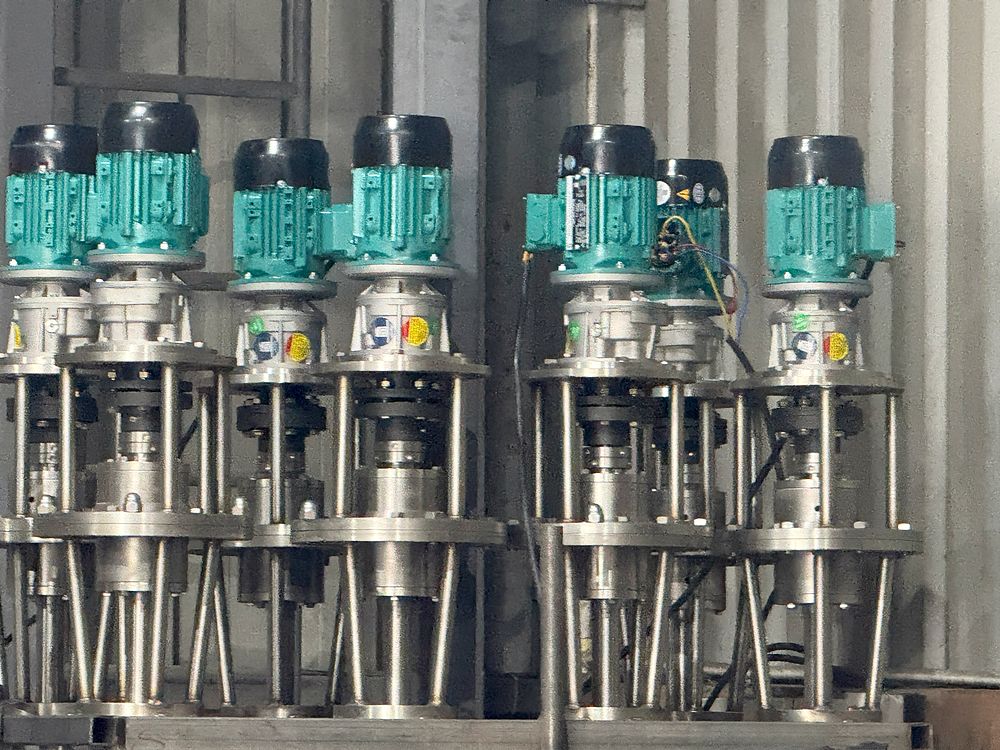
Drilling mud is a heavy suspension: barite or other weighting material, clay, polymers and drilled cuttings in water or oil. Left still, the solids settle in the corners of the tank, the density changes from top to bottom, and settled solids have to be dug out. A mud agitator on each compartment keeps the whole volume moving and the mud properties even, from the suction tank to the reserve and mixing tanks.
A mud agitator is a compact top entry agitator: a motor and gear reducer mounted on the tank top, a shaft and one or two turbine impellers near the bottom. We size the impeller, speed and power for the compartment dimensions and the mud weight, so the bottom stays clear without wasting power. The drive is flameproof where the area classification of the rig or plant requires it. Mud agitators also suit liquid mud plants, mud mixing and storage tanks, and bentonite slurry tanks for piling, tunnelling and horizontal drilling.
Where it is used
- Drilling rig mud tank systems
- Suction, reserve and pill tanks
- Mud mixing and storage tanks
- Liquid mud plants and mud terminals
- Bentonite slurry for piling and diaphragm walls
- Slurry tanks for tunnelling and horizontal drilling
How FMT builds it
| Drive | Motor with gear reducer, mounted on the tank top; flameproof motor where the area classification requires it |
|---|---|
| Impellers | Turbine impellers, one or two on the shaft, sized for the compartment and the mud weight |
| Shaft | Solid shaft, checked for stress, deflection and critical speed; bottom stabiliser where the shaft is long |
| Mounting | Base plate on the tank top or a beam across the compartment |
| Materials | Carbon steel shaft and impellers as standard; other materials on request |
| Finish | Paint system for outdoor rig and plant service |
The red lines show how the impeller moves the liquid. Every FMT unit is sized for its own vessel, product and duty, so yours is drawn for your tank in the offer.
Send your vessel for a drawingWhat we need to size it
- Tank or compartment length, width and height, and the working level
- Mud type (water, oil or synthetic base) and the highest mud weight
- Whether the tank is for suction, reserve, mixing or storage
- Power supply and hazardous-area classification of the rig or plant
- Number of compartments and any existing agitator mounting